Find us on:

Science & Technology


Star

Suitcase Science On The Moon

In October 1963, two cartographers with the Air Force Aeronautical Chart and Information Center saw a strange glow on the moon. Using the 24-inch refractor telescope at Lowell observatory in Flagstaff, Arizona, James Greenacre and Edward Barr saw a deep, ruby-red glow coming from the crater Aristarchus. The sighting might have been glowing gas from volcanic activity, and a second sighting in November of that year was verified by Dr. John Hall, Director of the observatory at the time.

Throughout history, there have been many more. There have been rumbles from other areas on the moon as well. For example, when Dr. Yosio Nakamura of the University of Texas, Austin, and his colleagues reviewed seismology data from the Apollo missions, they discovered there was a magnitude 5.7 moonquake near the lunar south pole, a possible site for a future lunar base.
Star

2000-Year-Old Meteors to Rain Down on August 31, 2007

The meteors that are about to rain down in the early morning of September 1 date from around 4 A.D., the latest calculations show.
Smiley

Why Harvard Bridge Is Measured in Smoots, Meters Are Inhuman

For two millennia, brilliant minds have been trying to find a logical system of measuring the world that everyone can agree upon. The stubborn persistence of yards, gallons and pounds in a world that mostly works in meters, liters and grams suggests how deep the disagreement has been.

While this doesn't bother British architect Robert Tavernor, it does fascinate him. In ''Smoot's Ear,'' he offers a brief history of humanity's effort to measure the world by scientific principle, even as science itself has changed our knowledge.
Bizarro Earth

Update: Rock Snot algae spreading - threatens New England waterways

It looks like a clump of soiled sheep's wool, a cottony green or white mass that's turning up on rocks and river bottoms, snarling waterways.

©AP Photo
Mary Russ, executive director of the White River Partnership, holds a rock covered with didymo in the White River in Stockbridge, Vt., Friday, July 27, 2007. The aquatic algae didymo -- Didymosphenia geminata -- has infested rivers in New Zealand with gray floating growth but had never been seen in the Northeast before this summer when fishermen spotted it in the upper Connecticut and White rivers. Northeast states are on alert. They're warning anglers and boaters to scour their boats and clean their gear to prevent the algae's spread.
Info

Pathocracy of Microworld: Microbial cheats orchestrate their own downfall

Cooperation is widespread in the natural world but so too are cheats - mutants that do not contribute to the collective good but simply reap the benefits of others' cooperative efforts. In evolutionary terms, cheats should indeed prosper, so how cooperation persists despite the threat of cheat takeover is a fundamental question. Recently, biologists at the Universities of Edinburgh and Oxford have found that in bacteria, cheats actually orchestrate their own downfall.

Comment: Read Political ponerology to understand Hysteroidal cycle and Pathocracy of Human world.

Telescope

Observations Of Asteroid Itokawa Will Aid In Assessing Risks From Future Asteroids

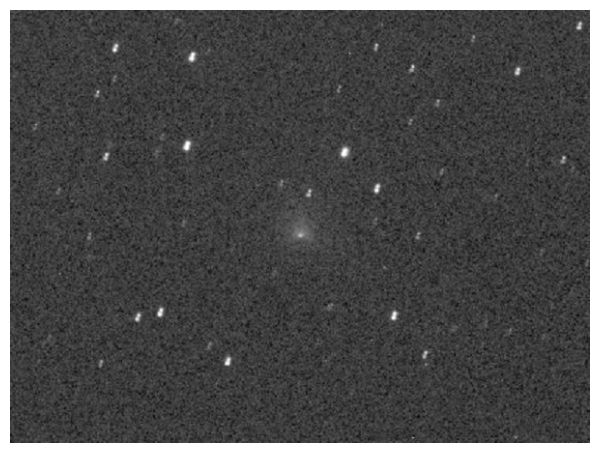
The space-borne infrared observatory AKARI, observed asteroid Itokawa last month with its Infrared Camera. The data will be used to refine estimates of sizes of potentially hazardous asteroids in the future.

©JAXA
The asteroid Itokawa was observed by the Infrared Camera (IRC) onboard AKARI at 7 micrometres on 26 July 2007. The above image is a composite of three images from the data showing the motion of Itokawa over 12 minutes. The image covers an area of roughly 7.4 arcminutes x 7.4 arcminutes around the target. The Hayabusa spacecraft itself was too faint to be detected.
Nuke

China searches for 8 kg of "missing" uranium

Eight kg (17 lb) of radioactive uranium has gone missing in China, delaying the verdict in a trial of four men charged with attempting to sell it on the black market, state media said on Friday.

A court in Guangzhou, capital of China's southern province of Guangdong, heard the four tried to sell the material between 2005 and January 2007, the China Daily said.

The men were arrested in January after a potential buyer in Hong Kong reported them to the authorities, the paper said.

However, despite having the four men in custody, police were unable to locate the uranium.
Magnify

Fossil find pushes human-ape split back millions of years

Ten million-year-old fossils discovered in Ethiopia show that humans and apes probably split six or seven million years earlier than widely thought, according to landmark study released Wednesday.

The handful of teeth from the earliest direct ancestors of modern gorillas ever found -- one canine and eight molars -- also leave virtually no doubt, the study's authors and experts said, that both humans and modern apes did indeed originate from Africa.
Bulb

Sony develops bio battery with sweet tooth

Sony has developed an environmentally-friendly prototype battery that runs on sugars and that can generate enough electricity to power a music player and a pair of speakers, the Japanese company said.

©Reuters
Telescope

Astronomers excited about nothing

Astronomers have stumbled upon a tremendous hole in the universe. That's got them scratching their heads about what's just not there.

The cosmic blank spot has no stray stars, no galaxies, no sucking black holes, not even mysterious dark matter. It is 1 billion light years across of nothing. That's an expanse of nearly 10 billion trillion kilometres of emptiness, a University of Minnesota team announced Thursday.