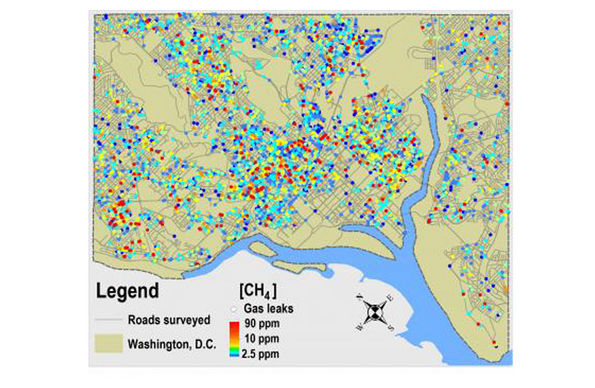
© Duke UniversityThis is a map of the District of Columbia showing where researchers found natural gas leaks under city streets, with colors indicating the concentration, in parts per million, of methane at each location.
Researchers from Duke University and Boston University mapped 1,500 road miles (2,400 kilometers) of underground infrastructure that delivers fuel to power homes and businesses in the nation's capital. Using a high-precision device to detect methane - the chief component of natural gas - the scientists discovered more than 5,893 natural gas leaks throughout the city.
The scientists also found some manholes with methane concentrations nearly 10 times greater than the threshold at which explosions can occur.
"Repairing these leaks will improve air quality, increase consumer health and safety, and save money," study lead author Robert Jackson, a professor of environmental sciences at Duke University, said in a statement.
"Pipeline safety has been improving over the last two decades. Now is the time to make it even better."
After their initial findings, the researchers reported the leaks to city authorities. Yet, four months later, nine leaks were still found to be emitting dangerous levels of methane, Jackson said.
"Finding the leaks a second time, four months after we first reported them, was really surprising," he said.