

© Credit: Thomas Deerinck, National Center for Microscopy and Imaging Research, UC San DiegoThis is a scanning micrograph of dividing cancer cells.
Specifically, principal investigator Albert R. La Spada, MD, PhD, professor of cellular and molecular medicine, chief of the Division of Genetics in the Department of Pediatrics and associate director of the Institute for Genomic Medicine at UC San Diego, and colleagues found that a microRNA known as let-7 controls autophagy through the amino acid sensing pathway, which has emerged as the most potent activator of mTORC1 complex activity.
Autophagy is a fundamental process used by cells to degrade unnecessary components in times of starvation, releasing energy stores that help promote cell survival. Cells have further adapted autophagy for other purposes as well, including recycling dysfunctional components, immune response to pathogen invasion, surveillance against cancer and maintenance of protein and organelle control in the central nervous system. MTORC1 is a critical protein complex that regulates energy consumption and growth in cells.




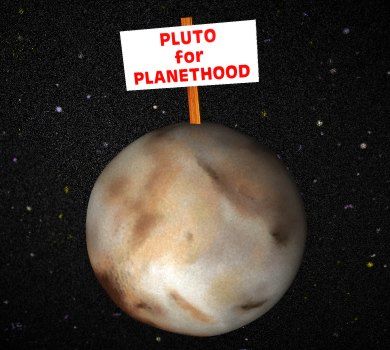













Comment: After the IAU decision to downgrade Pluto by four percent of its members, most of whom are not planetary scientists, it was immediately opposed in a formal petition by hundreds of professional astronomers. Part of the issue is that the term "minor planet" is a synonym for asteroids and comets, bodies too small to be rounded by gravity. Regardless of its size, Pluto still meets much of the planetary "criteria." The recent feel-good vote was not official nor binding.
As the bumpersticker says: Honk if Pluto is still a planet...
The video of the debate and audience vote can be seen on YouTube at https://www.youtube.com/user/ObsNights.