
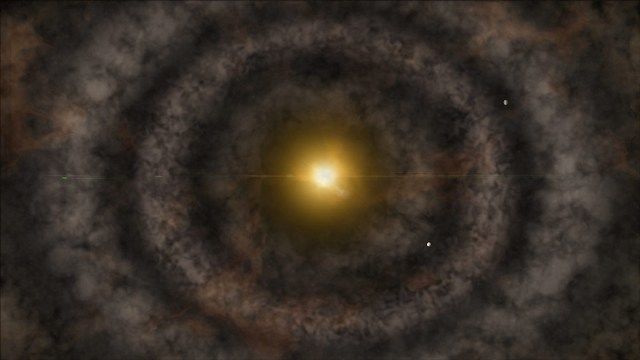
© ESO/L. CalçadaArtist's impression showing the gas and dust surrounding the triple star system GG Tau.
An international team of astronomers, including researchers at the LAB (CNRS/Université de Bordeaux), IPAG (CNRS/Université Joseph Fourier Grenoble 1) and IRAM (CNRS/MPG/IGN), has carried out the most accurate study so far of the cocoon of gas and dust surrounding the GG Tau A system. By combining complementary observations at submillimeter (ALMA and IRAM) wavelengths with those at infrared (VLTI/ESO) wavelengths, the researchers were able to identify the complex dynamics at work in GG Tau. For the first time, they detected motion of matter showing that exoplanets can form not only around one of the members of this trio of young stars, but also much further out in the disc surrounding the three stars. These observational findings, published in the October 30 issue of the journal
Nature, reveal a more complex story than originally thought.
Although recent observational discoveries have shown the existence of many planets orbiting double stars, their formation ran up against the problem of the gravitational instabilities caused by the binary nature of such stars.. Observations of young binary stars are still too scarce to provide a detailed picture of these processes. Until very recently, GG Tau A, located 450 light years from Earth in the constellation Taurus, was thought to be a binary system of two stars, Aa and Ab. However, recent infrared measurements carried out with the VLT and VLTI (ESO) instruments have shown that GG Tau A is in fact a triple star system: GG Tau Ab is itself a binary star. The central star Aa is far enough away from the Ab pair for it to be surrounded by a circumstellar disc, first observed in 2011 with the IRAM interferometer.
Around this triple star system the researchers have already identified a rotating disc of gas and dust, whose center is cleared by gravitational tidal effects. As the three stars orbit around one another, they create an unstable gravitational region called a cavity, through which matter can only travel before falling onto the central stars. Further away, where the outer ring of matter is located, the gravitational field is no longer disturbed, and the rotating matter can form a stable structure. The existence of a central cavity around GG Tau A, known since the 1990s thanks to observations with the IRAM interferometer, partially confirmed these theoretical predictions. In the 2000s, the presence of gas in the cavity was detected, but the precise dynamics of this gas, which is the key to understanding the accretion mechanisms giving rise to planets, remained largely unknown.








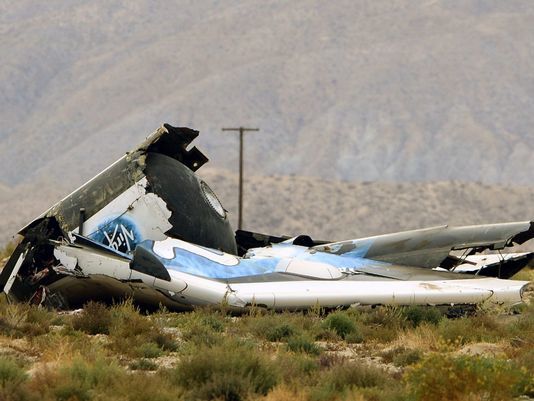




Comment: Variable geometry rudders can be "feathered" (rotated up 90 degrees) to increase drag and control vehicle yaw (a twisting or oscillation of a moving ship or aircraft around a vertical axis). They also reduce heating from friction. At 70,000 feet the rudders are de-feathered into gliding configuration.
Deploying the feather system is in two steps: move the lever to unlock, then move the lever to deploy. The co-pilot did the first but not the second step which is why it is called an "uncommanded" deploy. While the unlock was performed early on, they are not saying it was a pilot error that caused the crash. It is more likely a system failure of the second step, a tragic flaw unknowable by the pilot. A more thorough investigation will determine the final word on this fatal tragedy. As a totally commercial venture, the National Transportation Safety Board is the one handling the investigation.