Science & TechnologyS


Comet

Rosetta's comet sings a mysterious 'song'

Comet 67P
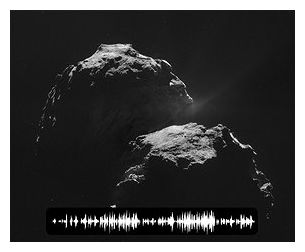
© ESA/Rosetta/NavCamThrough some kind of interaction in the comet's environment, 67P's weak magnetic field seems to be oscillating at low frequencies.
The Rosetta mission has detected a mysterious signal coming from Comet 67P/Churyumov-Gerasimenko.

The mission has five instruments in the Rosetta Plasma Consortium (RPC) that measure the plasma environment surrounding the comet.

Plasma is a charged gas and the RPC is tasked with understanding variations in the comet's activity, how 67P's jets of vapour and dust interacts with the solar wind and the dynamic structure of the comet's nucleus and coma.

But when recording signals in the 40-50 millihertz frequency range, the RPC scientists stumbled on a surprise - the comet was singing, they report.

Through some kind of interaction in the comet's environment, 67P's weak magnetic field seems to be oscillating at low frequencies. In an effort to better understand this unique 'song', mission scientists have increased the frequency 10,000 times to make it audible to the human ear.

Info

Thought control successfully used to switch on a gene

Star Wars
© Rex Features
Luke Skywalker strikes a protective pose behind Princess Leia in the 1977 series opener Star Wars.
Luke Skywalker mastering the mysterious "Force" in Star Wars has come a step closer to reality after an experiment where thought control was successfully used to switch on a gene and generate protein in an electronic chip.

Scientists believe the bizarre experiment, in which volunteers were wired up to a machine that read their brainwaves, could lead to mind-operated implants for treating disease.

The Swiss researchers compared the study to Luke Skywalker's power. They were inspired by the game Mindflex, in which players wearing headsets use their brainwaves to "thought control" a small ball through an obstacle course by operating a fan.

In the experiment, volunteers wore brainwave-recording headsets linked to an electrical current generator. By thinking in a certain way, they were able wirelessly to turn on the gene chip, causing it to emit near infra-red LED light.

This activated light-sensitive cells in the chip, triggering a cascade of signals and switching on the gene for a marker protein called SEAP (secreted embryonic alkaline phosphatase).

Implanted into mice, the chip released the protein into the animals' bloodstreams.

Bizarro Earth

Solar eclipse in March 2015 threatens Europe solar grid, temp 'may drop 6 C in 30 minutes'

solar eclipse
© Reuters / Goran TomasevicA partially eclipsed sun is seen from Juba November 3, 2013
When an almost total solar eclipse starts on March 20, 2015 and casts an umbra on northern Europe, it may face an unprecedented test of its electricity grid due to the massive development of solar power production.

The warning comes from the French power grid RTE, which said Friday that Europe must be prepared for the event.

"The passage of this shadow will considerably reduce photovoltaic power production," Dominique Maillard, the head of RTE, told reporters during its winter outlook presentation, as cited by Reuters."According to our calculations, the impact could be a drop in production of as much as 30,000 megawatts across Europe, it's the equivalent of a six degrees Celsius drop in temperatures in half an hour."

Ice Cube

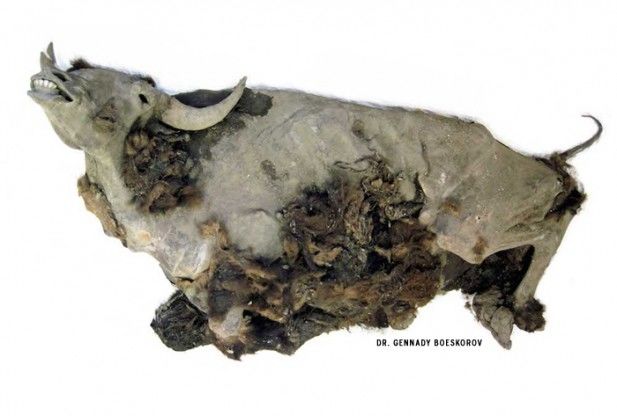
Mummified bison uncovered in Siberia

Image
© Dr. Gennady Boeskorov
Researchers have uncovered the several thousand year old, mummified remains of an extinct species of bison in a region of eastern Siberia known as the Yana-Indigirka Lowland, according to research presented at the annual meeting of the Society of Vertebrate Paleontology (SVP) in Berlin, Germany.

The mummy was a near-complete specimen of Steppe bison and was discovered by a team of experts led by Dr. Natalia Serduk of the Russian Academy of Sciences. The creature is reportedly 9,300 years old and has a complete brain, heart, blood vessels, digestive system and even intact fur, though the researchers explained that some of the organs have shrunk significantly over time. A necropsy of the animal found no obvious cause of death.

"Normally, what you find with the mummies of megafauna in North America or Siberia is partial carcasses. They're partly eaten or destroyed because they're lying in the permafrost for tens of thousands of years," Olga Potapova of the Mammoth Site of Hot Springs in South Dakota told Live Science reporter Elizabeth Palermo. "But the mummy was preserved so well that it [earned] a record for the level of its preservation."

Comment: See also: What killed the woolly mammoth? UCSB Professor finds evidence to support comet collision

A giant meteor - not overhunting - wiped out the woolly mammoth because it struggled to cope with the rapid climate change that followed

A comet may have caused widespread large mammal extinctions 12,900 years ago


Info

Virus that 'makes humans more stupid' discovered

Stupid Virus
© The Independent, UKA virus has been discovered that affects cognitive abilities in healthy people.
A virus that infects human brains and makes us more stupid has been discovered, according to scientists in the US.

The algae virus, never before observed in healthy people, was found to affect cognitive functions including visual processing and spatial awareness.

Scientists at Johns Hopkins Medical School and the University of Nebraska stumbled upon the discovery when they were undertaking an unrelated study into throat microbes.

Surprisingly, the researchers found DNA in the throats of healthy individuals that matched the DNA of a virus known to infect green algae.

Dr Robert Yolken, a virologist who led the original study, said: "This is a striking example showing that the 'innocuous' microorganisms we carry can affect behaviour and cognition.

Info

Creepy cockroaches could be used for search and rescue

Cockroach
© Thinkstock
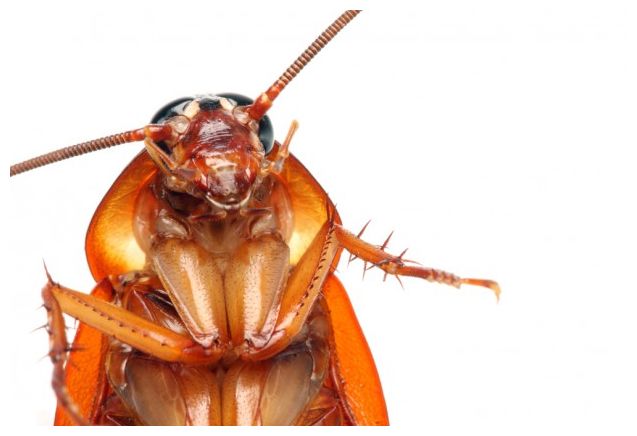
Researchers from North Carolina State University (NCSU) have found a way to turn cockroaches into cyborgs and have them assist in search and rescue operations after major disasters.

By wearing special backpacks, the "biobots" can detect and locate sound, as well as differentiating between important and unimportant sounds.

The scientists came up with two innovations, both of which involve electronic backpacks which are equipped with microphones.

One has a single microphone that can capture relatively high-resolution sound from any direction which can then be wirelessly transmitted to first responders.

The other involves an array of three-directional microphones which can detect the direction of the sound. The team also developed algorithms that can analyze sound from the microphone array to focus the source and steer the biobot in the right direction.

The microphone array system worked successfully in laboratory testing, as shown in a video below.

Comet

Rosetta mission: Europe set to make space history with comet landing

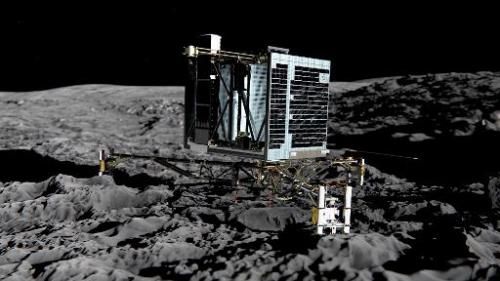
Rosetta's lander Philae
Photo released by the European Space Agency shows an artist impression of Rosetta's lander Philae (back view) on the surface of comet 67P/Churyumov-Gerasimenko
One of the biggest gambles in space history comes to a climax on Wednesday when Europe attempts to make the first-ever landing on a comet.

Speeding towards the Sun at 65,000 kilometres (40,600 miles) per hour, a lab called Philae will detach from its mothership Rosetta, heading for a deep-space rendezvous laden with risk.

The 100-kilogram (220-pound) probe will seek out a minuscule landing site on the treacherous surface of an object darker than coal, half a billion kilometres (300 million miles) from home.

"It's not going to be an easy business," was the understated prediction of Philippe Gaudon of France's National Centre for Space (CNES) as the mission prepared to enter countdown mode.

The stakes facing Rosetta managers in Darmstadt, Germany are daunting as the 1.3-billion-euro ($1.61-billion) project reaches a peak.

Two decades of work have been poured into what could be a crowning moment in space exploration.


Comment: A 'crowning moment' or perhaps a big disappointment? As Wallace Thornhill states in the video below: "The greatest danger to the Rosetta mission may come from not understanding the electrical nature of comets."


Comment: Wallace Thornhill comments on the Rosetta mission:


Arrow Down

Google wants to store your genome

Genome Storage
© www.technologyreview.com
Google is approaching hospitals and universities with a new pitch. Have genomes? Store them with us.

The search giant's first product for the DNA age is Google Genomics, a cloud computing service that it launched last March but went mostly unnoticed amid a barrage of high profile R&D announcements from Google, like one late last month about a far-fetched plan to battle cancer with nanoparticles (see "Can Google Use Nanoparticles to Search for Cancer?").

Google Genomics could prove more significant than any of these moonshots. Connecting and comparing genomes by the thousands, and soon by the millions, is what's going to propel medical discoveries for the next decade.

The question of who will store the data is already a point of growing competition between Amazon, Google, IBM, and Microsoft.

Google began work on Google Genomics 18 months ago, meeting with scientists and building an interface, or API, that lets them move DNA data into its server farms and do experiments there using the same database technology that indexes the Web and tracks billions of Internet users.

"We saw biologists moving from studying one genome at a time to studying millions," says David Glazer, the software engineer who led the effort and was previously head of platform engineering for Google+, the social network. "The opportunity is how to apply breakthroughs in data technology to help with this transition."

Some scientists scoff that genome data remains too complex for Google to help with. But others see a big shift coming. When Atul Butte, a bioinformatics expert at Stanford heard Google present its plans this year, he remarked that he now understood "how travel agents felt when they saw Expedia."

Fireball 4

Warning for Earth: Comet Siding Spring's near-brush with Mars triggered 'mind blowing' meteor shower

Image
© NASA
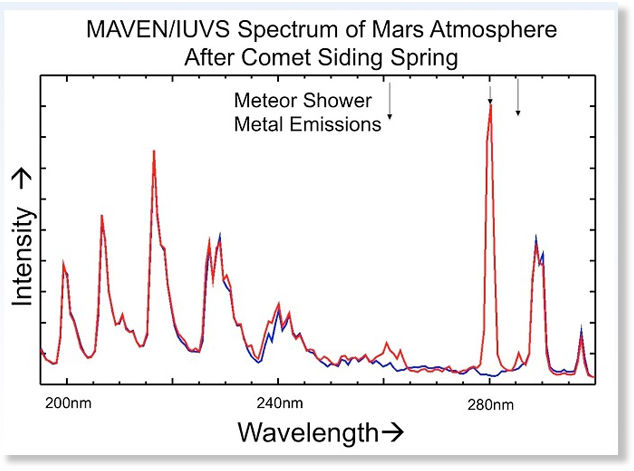
Comet Siding Spring's close flyby of Mars last month dumped several tons of primordial dust into the thin martian atmosphere, likely creating a brief but spectacular meteor shower with thousands of shooting stars per hour had any astronauts been there to see it, scientists said Friday.

The comet dust also posed a much more serious threat than expected to an international fleet of spacecraft in orbit around the red planet and roving about its surface. While engineers did not think the comet posed a major hazard, the orbiters were maneuvered to put them on the far side of Mars during close approach. Just in case.

As it turned out, that was a smart decision.

"After observing the effects on Mars and how the comet dust slammed into the upper atmosphere, it makes me very happy that we decided to put our spacecraft on the other side of Mars at the peak of the dust tail passage and out of harm's way," Jim Green, director of planetary science at NASA headquarters, told reporters during a teleconference. "I really believe that hiding them like that really saved them, and it gave us a fabulous opportunity to make these observations."

Comment: If NASA et al had been paying even the slightest attention to what is happening here on Earth, rather than guess-timating with their fancy gadgets what might have happened on Mars, they'd realize they have plenty of real-life exploding comet fragments and comet dust to analyze right here at home.

Check out the astonishing afterglow caused by this exploding meteor over Recife, Brazil last month:

Meteor fireball sets the sky on fire over Recife, Brazil


Info

Singing hermit thrush uses harmony like humans

Image
© Matt MacGillivray Hermit thrush.
The song of the hermit thrush, a common North American songbird, share characteristics found in much human music - the harmonic series.

Researchers from the University of Vienna, the Cornish College of the Arts, USA, and the Philipps University of Marburg, Germany, have been able to demonstrate note selection from the harmonic series in a non-human animal.

The study is published in the scientific journal PNAS (Proceedings of the National Academy of Sciences).