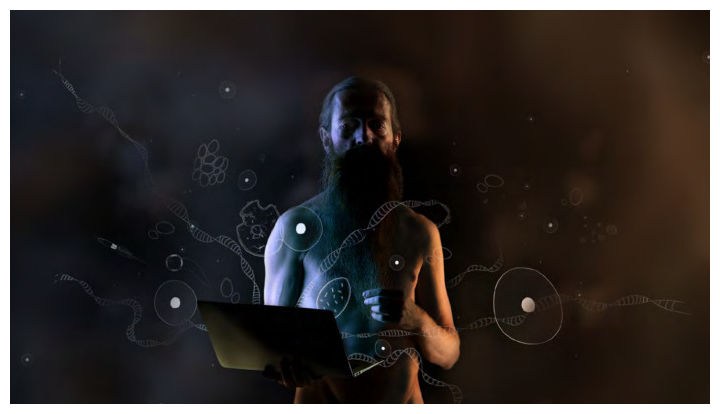
© Lucy Reading-IkkandaAn artist's rendering of a new "designer chromosome" shows red and blue pins and white diamonds at the spots where scientists engineered changes to the original chromosome. Yellow sections show where material was deleted to make the synthetic version.
Scientists have managed to re-engineer a form of brewer's yeast in a way that could help with the development of new types of drugs.
Researchers have chopped, spliced and manipulated DNA to craft the first extensively modified "designer chromosome," a genetic structure carefully engineered to spur scientific discovery.
The work is being hailed as a bioengineering feat and an important step toward producing a complex organism -- in this case brewer's yeast -- with a custom-made synthetic genome, or genetic blueprint. The research paves the way for producing new medicines and even biofuels from life forms with artificial chromosomes.
Artificial chromosomes have been built before. But those were relatively faithful copies of natural chromosomes, the tiny thread-like structures made of tightly packed DNA that serve as the body's blueprints. By contrast, the new chromosome is a product of purposeful tinkering, but the yeast that carry it act like normal yeast.
Previous artificial chromosomes were "copy-and-paste, more or less. It was plagiarism with a few edit marks in it," says Adam Arkin of the University of California-Berkeley and the Lawrence Berkeley National Laboratory, who was not involved in the research. The new structure is "a serious redesign of a chromosome with lots of very clever ways of ... making it more engineerable and more understandable."
The result "is a tour-de-force in synthetic biology," Boston University's James Collins, another outside researcher, says via e-mail.