Find us on:

Science & Technology


Robot

Hedonistic robots could destroy humanity

Robot
© Shutterstock
Complex robots are like animals: They learn by doing. Future robots may even respond to reward systems: complete a task with aplomb, and a gain a "feeling" of satisfaction for a job well done.

While this technology could create more efficient, goal-oriented robots, it could also have some very dire ramifications for humanity. After all, robots that feel rewarded by making humans happy may eventually decide that if no humans exist, no human will ever be unhappy again.

"Robots without preferences can't have complicated behaviors," Roman V. Yampolskiy, director of the Cybersecurity Research Lab at the University of Louisville, told TechNewsDaily. "To make machines which are independent and creative, we need to give them rewards and preferences."

While Yampolskiy believes that robots can be indispensible tools, he also warns that as they learn to seek rewards, they may learn to circumvent helping humans. "I am trying to make sure that any AI software we develop is safe to use and beneficial to humanity," he said.

Yampolskiy asserts that robots with the capacity for feelings of pleasure would, in all likelihood, take all the same shortcuts that humans use to acquire it. In a recent paper, he described the process of "wireheading," which sent an electric jolt through the pleasure center of a rat's brain. "The rat's self-stimulation behavior completely displaced all interest in sex, sleep, food and water, ultimately leading to premature death," Yampolskiy wrote.
Fireball 5

Huge rock crashes into moon, sparks giant explosion

Moon Impact
© NASA
This artist's illustration shows a meteor crashing into the surface of the moon. Scientists say hundreds of space rocks impact the lunar surface every year.
The moon has a new hole on its surface thanks to a boulder that slammed into it in March, creating the biggest explosion scientists have seen on the moon since they started monitoring it.

The meteorite crashed on March 17, slamming into the lunar surface at a mind-boggling 56,000 mph (90,000 kph) and creating a new crater 65 feet wide (20 meters).

The crash sparked a bright flash of light that would have been visible to anyone looking at the moon at the time with the naked eye, NASA scientists say.

"On March 17, 2013, an object about the size of a small boulder hit the lunar surface in Mare Imbrium," Bill Cooke of NASA's Meteoroid Environment Office said in a statement.

"It exploded in a flash nearly 10 times as bright as anything we've ever seen before."
Moon Impact_1
© NASA
This photo shows the bright flash of the light that resulted from a huge boulder slamming into the moon's surface March 17, 2013.
NASA astronomers have been monitoring the moon for lunar meteor impacts for the past eight years, and haven't seen anything this powerful before.

Scientists didn't see the impact occur in real time. It was only when Ron Suggs, an analyst at NASA's Marshall Space Flight Center in Huntsville, Ala., reviewed a video of the bright moon crash recorded by one of the moon monitoring program's 14-inch telescopes that the event was discovered.

"It jumped right out at me, it was so bright," Suggs said.

Scientists deduced the rock had been roughly 1-foot-wide (between 0.3 to 0.4 meters) and weighted about 88 lbs (40 kg).The explosion it created was as powerful as 5 tons of TNT, NASA scientists said.

When researchers looked back at their records from March, they found that the moon meteor might not have been an isolated event.

Comment: It's rather nice of NASA to just now inform us of this though there were rumors of this event and nothing to attach to it at the time from the MSM. Just for fun, take a peek at the large number of meteor sightings here on the BBM around that same time.

Comet

1998 QE2 asteroid as big as 19 Royal Cruise liners

Nasa scientists are getting excited about seeing the QE2 in the hope it will reveal crucial new insights. But it is not Her Majesty's defunct steam liner which is lying in dock in Dubai which has set stargazers in Houston, Texas, agog. The object is an asteroid flying through space which is as big as 19 of the former royal vessel. It measures 1.7 miles in length.
1998 QE2 is set to come close to our world when it flys past in its orbit of the sun, on May 31. Scientists will use the Near Earth Object (NEO) event to help plan for an audacious bid to land on a lump of space rock in four years time as part of asteroid defence planning. Nasa scientist Lance Benner said: Whenever an asteroid approaches this closely, it provides an important scientific opportunity to study it in detail to understand its size, shape, rotation, surface features, and what they can tell us about its origin.

"We will also use new radar measurements of the asteroid's distance and velocity to improve our calculation of its orbit and compute its motion farther into the future than we could otherwise." Earth's upcoming brush with an extra-terrestial object should not contain the risk of causing chaos for us on earth, like the Russian meteor earlier this year. 1998 QE2 shall fly past earth 3.6m miles above our heads. A Nasa spokesman claimed there is no connection between the asteroid and the British royal cruise ship.
Fireball 5

Asteroid 1998 QE2 to sail past earth

Asteroid 1998 QE2
© NASA/JPL-Caltech
Asteroid 1998 QE2 will get no closer than about 3.6 million miles at time of closest approach on May 31 at 1:59 p.m. Pacific (4:59 p.m. Eastern).
On May 31, 2013, asteroid 1998 QE2 will sail serenely past Earth, getting no closer than about 3.6 million miles (5.8 million kilometers), or about 15 times the distance between Earth and the moon. And while QE2 is not of much interest to those astronomers and scientists on the lookout for hazardous asteroids, it is of interest to those who dabble in radar astronomy and have a 230-foot (70-meter) -- or larger -- radar telescope at their disposal.

"Asteroid 1998 QE2 will be an outstanding radar imaging target at Goldstone and Arecibo and we expect to obtain a series of high-resolution images that could reveal a wealth of surface features," said radar astronomer Lance Benner, the principal investigator for the Goldstone radar observations from NASA's Jet Propulsion Laboratory in Pasadena, Calif. "Whenever an asteroid approaches this closely, it provides an important scientific opportunity to study it in detail to understand its size, shape, rotation, surface features, and what they can tell us about its origin. We will also use new radar measurements of the asteroid's distance and velocity to improve our calculation of its orbit and compute its motion farther into the future than we could otherwise."

The closest approach of the asteroid occurs on May 31 at 1:59 p.m. Pacific (4:59 p.m. Eastern / 20:59 UTC). This is the closest approach the asteroid will make to Earth for at least the next two centuries. Asteroid 1998 QE2 was discovered on Aug. 19, 1998, by the Massachusetts Institute of Technology Lincoln Near Earth Asteroid Research (LINEAR) program near Socorro, New Mexico.
Comet 2

Comet Lemmon undergoes 'disconnection event'

Comet Lemmon (C/2012 F6), which is receding from the sun not far beyond the orbit of Earth, has just experienced a "disconnection event." A cloud of dusty plasma is propagating down the comet's tail, shown here in a photo taken by amateur astronomer Paul Mortfield on May 15th:

RCOS 16 f/8.9, STL11K, 5x2minutes
Sierra Remote Observatories, California MPC: G80
"I was pretty surprised to see this disconnection event when I processed the images," says Mortfield. "The comet is a challenge to photograph because it is so low in the sky at the start of morning twilight."

Disconnection events can be caused by CME impacts. A famous example is that of Comet Encke in 2007. Comet Lemmon, however, is not on the same side of the sun as active sunspot AR1748. It's hard to see how the recent X-flares can be responsible. Nevertheless, solar activity is high, so now is a good time to monitor comet tails. They are very sensitive to stormy space weather.
Comet 2

Mars bombarded by more than 200 small asteroids or bits of comets per year

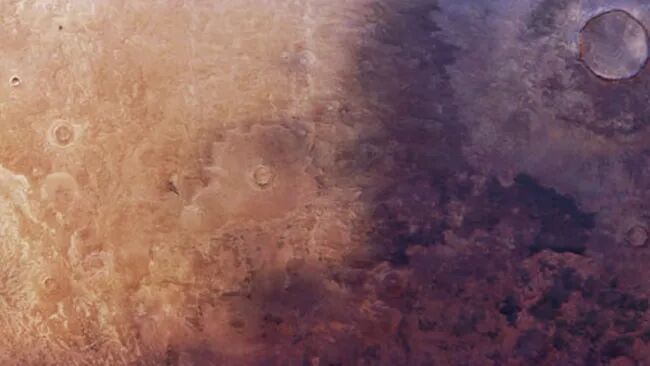
Scientists using images from NASA's Mars Reconnaissance Orbiter (MRO) have estimated that the planet is bombarded by more than 200 small asteroids or bits of comets per year forming craters at least 12.8 feet (3.9 meters) across. Researchers have identified 248 new impact sites on parts of the Martian surface in the past decade, using images from the spacecraft to determine when the craters appeared. The 200-per-year planetwide estimate is a calculation based on the number found in a systematic survey of a portion of the planet.

MRO's High Resolution Imaging Science Experiment (HiRISE) camera took pictures of the fresh craters at sites where before-and-after images by other cameras bracketed when the impacts occurred. This combination provided a new way to make direct measurements of the impact rate on Mars. This will lead to better age estimates of recent features on Mars, some of which may have been the result of climate change.
© NASA

"It's exciting to find these new craters right after they form," said Ingrid Daubar of the University of Arizona, Tucson, lead author of the paper published online this month by the journal Icarus. "It reminds you Mars is an active planet, and we can study processes that are happening today."

These asteroids or comet fragments typically are no more than 3 to 6 feet (1 to 2 meters) in diameter. Space rocks too small to reach the ground on Earth cause craters on Mars because the Red Planet has a much thinner atmosphere.
Sun

4 huge solar flares in 48 hours: What's going on with the sun?

An overachieving sunspot on the surface of the sun unleashed its fourth major solar flare in two days late Tuesday (May 14), a solar storm that may deal Earth a glancing blow, space weather experts say. The active sunspot AR1748 roared to life Tuesday night releasing an X-class solar flare - the strongest type the sun can experience - that peaked at 9:48 p.m. EDT (0148 May 15 GMT), according to NOAA's Space Weather Prediction Center in Boulder, Colo. The flare came after a relative lull in activity from sunspot AR1748, which fired off three monster X-class solar flares within a 24-hour period between Sunday and Monday.


In a morning update, NOAA space weather officials said they are studying this latest solar flare from AR1748 to see if it coincided with an eruption of super-hot solar plasma known as a coronal mass ejection, or CME. Such explosions can unleash huge waves of charged solar material streaking out into space at millions of miles per hour. "Too early to know if a CME occurred. If one did, it may just glance the Earth's magnetic field, given its off-center location still," SWPC officials said. "Forecasters are pondering that one."
Info

Ruins of lost city may lurk deep in Honduras rain forest

Lost City?
© UTL Scientific, LLC
Lidar technology allows researchers to strip away the green forest canopy and reveals features beneath, including this mysterious mound that may be a sign of ancient civilization in the Honduras rainforest.
New images of a possible lost city hidden by Honduran rain forests show what might be the building foundations and mounds of Ciudad Blanca, a never-confirmed legendary metropolis.

Archaeologists and filmmakers Steven Elkins and Bill Benenson announced last year that they had discovered possible ruins in Honduras' Mosquitia region using lidar, or light detection and ranging. Essentially, slow-flying planes send constant laser pulses groundward as they pass over the rain forest, imaging the topography below the thick forest canopy.

What the archaeologists found - and what the new images reveal - are features that could be ancient ruins, including canals, roads, building foundations and terraced agricultural land. The University of Houston archaeologists who led the expedition will reveal their new images and discuss them today (May 15) at the American Geophysical Union Meeting of the Americas in Cancun.
Magic Wand

New principle may help explain why nature is quantum

© Timothy Yeo / CQT, National University of Singapore
A principle of 'accepting the facts' implies that a quantum bit (typically pictured as a 'Bloch ball') can look like a sphere but not like a polyhedron. Polyhedral bits have been linked to theories of discrete spacetime. By ruling out various alternative theories of nature, the principle may help to explain why the world is quantum.
Like small children, scientists are always asking the question 'why?'. One question they've yet to answer is why nature picked quantum physics, in all its weird glory, as a sensible way to behave. Researchers Corsin Pfister and Stephanie Wehner at the Centre for Quantum Technologies at the National University of Singapore tackle this perennial question in a paper published 14 May in Nature Communications.

We know that things that follow quantum rules, such as atoms, electrons or the photons that make up light, are full of surprises. They can exist in more than one place at once, for instance, or exist in a shared state where the properties of two particles show what Einstein called "spooky action at a distance", no matter what their physical separation. Because such things have been confirmed in experiments, researchers are confident the theory is right. But it would still be easier to swallow if it could be shown that quantum physics itself sprang from intuitive underlying principles.

One way to approach this problem is to imagine all the theories one could possibly come up with to describe nature, and then work out what principles help to single out quantum physics. A good start is to assume that information follows

Einstein's special relativity and cannot travel faster than light. However, this alone isn't enough to define quantum physics as the only way nature might behave. Corsin and Stephanie think they have come across a new useful principle. "We have found a principle that is very good at ruling out other theories," says Corsin.
Sun

Hyperactive sun fires off 3 major solar flares in 1 day in biggest storm so far this year

X2.8 class solar flare
© NASA/SDO
On May 13, 2013, an X2.8-class flare erupted from the sun -- the strongest flare of 2013 to date. This NASA image shows a close-up of the flare as seen by the Solar Dynamics Observatory in the 131 angstrom wavelength.
The sun, it seems, is in overdrive. Late Monday night, the sun unleashed its third major solar flare in 24 hours - the biggest and most powerful solar storm of the year, so far.

This latest sun storm erupted Monday (May 13) at 9:11 p.m. EDT (0111 GMT) and registered as an X3.2 solar flare, one of the strongest types of flares the sun can release, space weather officials said. It came on the heels of two other recent X-class solar flares on Sunday night and Monday, all of which were sparked by a highly active sunspot on the sun's far left side.

Officials at the NOAA Space Weather Prediction Center in Boulder, Colo., appeared amazed at the intense activity from the crackling sunspot.