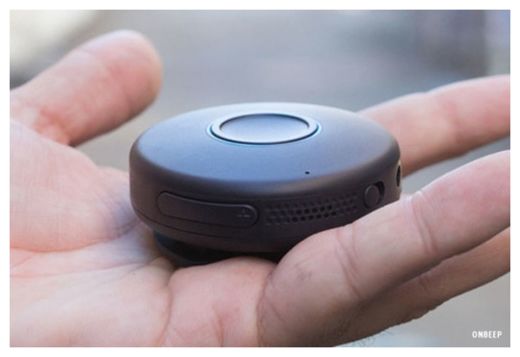
© OnBeep
Much like old-school
Star Trek communicators are often credited for being the inspiration of the smartphone, the devices used by Captain Picard and his crew on
Star Trek: The Next Generation have apparently given rise to a new wearable communication gadget developed by San Francisco startup
OnBeep.
The device is known as Onyx ($99), and links up to a smartphone via Bluetooth, according to Dan Seifert of
The Verge. At about 2.5 inches in diameter, this hockey puck-shaped device can clip to a bag or an article of clothing, and works anywhere with Wi-Fi or cellular data service.
Featuring a button in the middle to start conversation, the Onyx also has a volume rocker, a power switch and a mute function. The conversation button is surrounded by an LED ring that changes color based on your availability - blue for available, green for talking and yellow for muted. And, as
SlashGear's Chris Burns noted, it can connect to an Android or iOS app to track other Onyx owners and launch discussions that can be heard by all members of a group.
Seifert, who was able to give the device a test-drive, said it was similar to using a
walkie-talkie, except without range limits, static and the occasional interference experienced with those old-school devices. He noted that the audio quality was "quite good," that is used a low latency codec to minimize bandwidth, and that it was lightweight enough to be "clipped to a belt or shirt pocket" without being uncomfortable of impeding movement - something the company spent months
perfecting.










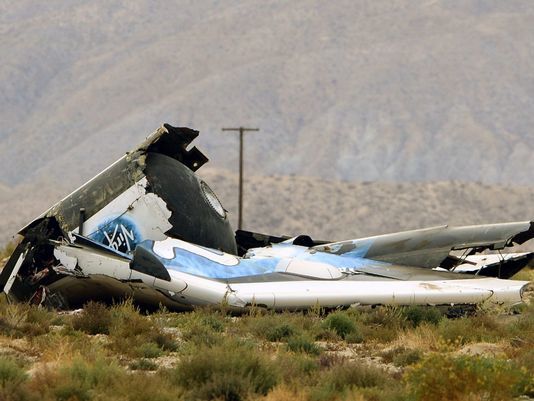



Comment: Variable geometry rudders can be "feathered" (rotated up 90 degrees) to increase drag and control vehicle yaw (a twisting or oscillation of a moving ship or aircraft around a vertical axis). They also reduce heating from friction. At 70,000 feet the rudders are de-feathered into gliding configuration.
Deploying the feather system is in two steps: move the lever to unlock, then move the lever to deploy. The co-pilot did the first but not the second step which is why it is called an "uncommanded" deploy. While the unlock was performed early on, they are not saying it was a pilot error that caused the crash. It is more likely a system failure of the second step, a tragic flaw unknowable by the pilot. A more thorough investigation will determine the final word on this fatal tragedy. As a totally commercial venture, the National Transportation Safety Board is the one handling the investigation.