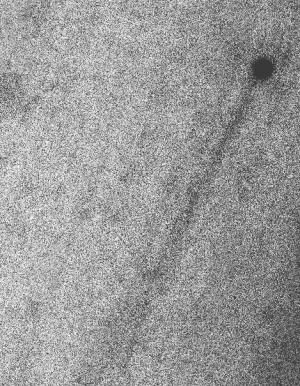
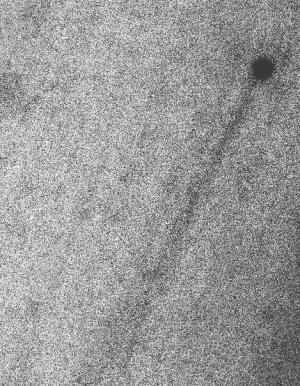
© Credit: Scott Sheppard The faint tail can be seen in active asteroid 62412.
A two-person team of Carnegie's Scott Sheppard and Chadwick Trujillo of the Gemini Observatory has discovered a
new active asteroid, called 62412, in the Solar System's main asteroid belt between Mars and Jupiter. It is the
first comet-like object seen in the Hygiea family of asteroids. Sheppard will present his team's findings at the American Astronomical Society's Division of Planetary Sciences meeting and participate on Tuesday, November 11, in a press conference organized by the society.
Active asteroids are a newly recognized phenomenon. 62412 is only the 13th known active asteroid in the main asteroid belt. Sheppard and Trujillo estimate that there are likely about 100 of them in the main asteroid belt, based on their discovery.
Active asteroids have stable orbits between Mars and Jupiter like other asteroids. However,
unlike other asteroids, they sometimes have the appearance of comets, when dust or gas is ejected from their surfaces to create a sporadic tail effect. Sheppard and Trujillo discovered an unexpected tail on 62412, an object which had been known as a typical asteroid for over a decade. Their findings reclassify it as an active asteroid.
The reasons for this loss of material and subsequent tail in active asteroids are unknown, although there are several theories such as recent impacts or sublimation from solid to gas of exposed ices.
"Until about ten years ago, it was pretty obvious what a comet was and what a comet wasn't, but that is all changing as we realize that not all of these objects show activity all of the time," Sheppard said.
In the past, asteroids were thought to be mostly unchanging objects, but an improved ability to observe them has allowed scientists to discover tails and comas, which are the thin envelope of an atmosphere that surrounds a comet's nucleus.
Comment: "The fundamental difference between asteroids and comets is not their chemical composition, i.e. dirty, fluffy icy comets vs. rocky asteroids. Rather, as has long been put forward by plasma theorists, what differentiates 'comets' from 'asteroids' is their
electric activity"
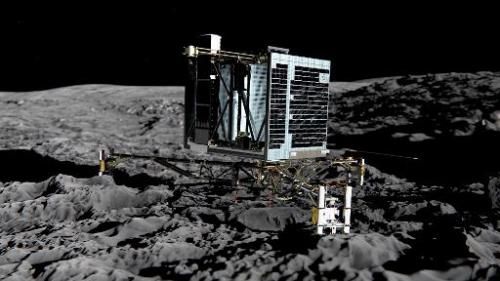
Earth Changes and the Human Cosmic ConnectionAs the Rosetta mission is currently lining up to deploy its robotic Philae lander to the comet 67P/Churyumov-Gerasimenko later today, scientists are already discovering new information that is significantly altering their understanding of comets.
"Yet new information is already pouring in. What scientists have discovered is already starting to
transform our understanding of
Rosetta's target comet, 67P/Churyumov-Gerasimenko (C-G for short), and
cometary science."
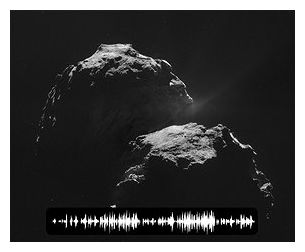
1. C-G looks nothing like we'd expect
2. The surface is hotter than we guessed, and surprisingly ice-free
3. Despite its dry surface, C-G expels an astronomical amount of water... but not on its dark side
Wheres the ice 3 surprising comet facts we've already learned from Rosetta










Comment: "The fundamental difference between asteroids and comets is not their chemical composition, i.e. dirty, fluffy icy comets vs. rocky asteroids. Rather, as has long been put forward by plasma theorists, what differentiates 'comets' from 'asteroids' is their electric activity"
Earth Changes and the Human Cosmic Connection
As the Rosetta mission is currently lining up to deploy its robotic Philae lander to the comet 67P/Churyumov-Gerasimenko later today, scientists are already discovering new information that is significantly altering their understanding of comets.
"Yet new information is already pouring in. What scientists have discovered is already starting to transform our understanding of Rosetta's target comet, 67P/Churyumov-Gerasimenko (C-G for short), and cometary science." Wheres the ice 3 surprising comet facts we've already learned from Rosetta