Science & TechnologyS


Question

Extreme storms erupt on Uranus, baffling astronomers

Uranus Storm
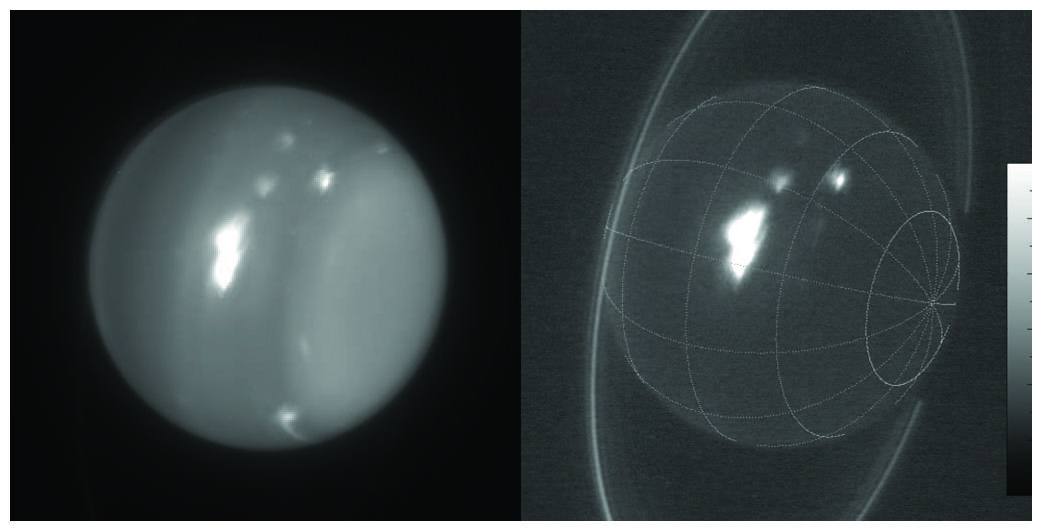
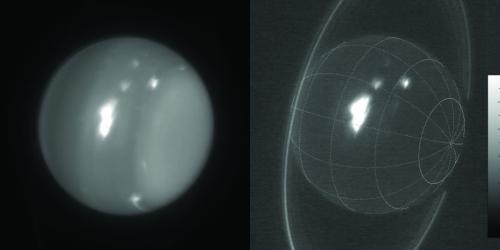
© Imke De Pater(UC Berkeley) & W. M. Keck Observatory ImagesThese infrared images of the planet Uranus show a white spot that is actually a massive storm on the planet. This image was recorded by the Keck II telescope atop Mauna Kea in Hawaii on Aug. 6, 2014 in the 2.2-micron wavelength.
Uranus is finally having some summer storms, seven years after the planet reached its closest approach to the sun, leaving scientists wondering why the massive storms are so late.

The usually quiet gas giant now has such "incredibly active" weather that some of the features are even visible to amateurs, said Imke de Pater, the project's lead researcher and an astronomer at the University of California, Berkeley. Astronomers first announced the extreme storms on Uranus in August, and have been trying to understand them ever since.

This is by far the most active weather de Pater's team has seen on Uranus in the past decade, examining its storms and northern convective features. It also paints a different picture of the quiet planet Voyager 2 saw when the NASA spacecraft flew by in 1986.

Comet 2

Philae records audio of comet 67P that sounds a lot like alien "Predator"

Image
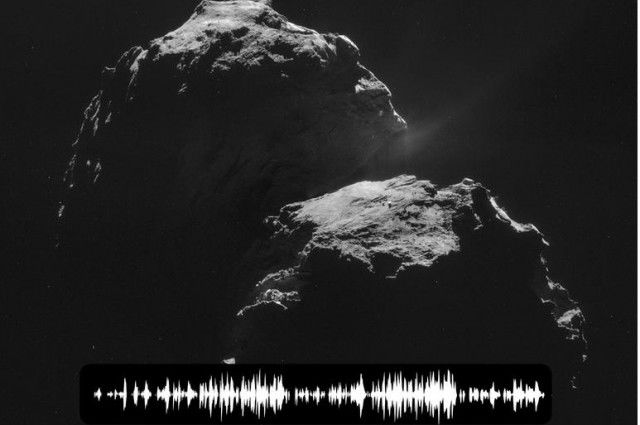
© ESA/Rosetta/NavCamArtist's impression of the 'singing comet' 67P/Churyumov-Gerasimenko
The Rosetta spacecraft and its Philae lander have a lot to teach scientists about what Comet 67P/Churyumov-Gerasimenko looks like, is composed of, and even what it smells like, but what does the comet sound like? The day before Philae made history by landing on the surface of the comet, ESA released an audio clip of 67P/C-G singing. Unfortunately, its song is creepy as hell and sounds a lot like Predator, the alien that tried to kill Arnold Schwarzenegger.

Of course, sound waves can't travel through space, so it isn't a direct audio recording. Instead, Rosetta's Plasma Consortium (RPC) picked up variations in the magnetic field around the comet, due to interactions between 67P/C-G's coma and the plasma from the Sun, better known as solar wind. These variations resulted in frequencies between 40 to 50 millihertz, about 10,000 times lower than can be detected by humans. ESA scientists altered the frequency of the comet's song into human hearing range, and discovered it was a series of clicks that are very reminiscent of Predator's growl.

Magic Wand

Dutch designer creates new font to help dyslexic readers navigate text

opendyslexic type face
A designer who has dyslexia has created a font to help dyslexic readers navigate text, designing letters in a way that avoids confusion and adds clarity. And in England, two researchers are compiling a dictionary that favors meaning over alphabetical order.

Roughly 10 percent of the world's population is dyslexic. And as NPR's Nancy Shute reported in 2012, "People with dyslexia are often bright and verbal, but have trouble with the written word."

The people behind two new projects hope they can help change that.

Dutch designer Christian Boer's Dyslexie font has been around for a while, but it's been getting new attention thanks to being featured in the Istanbul Design Biennial.

Comet 2

Rosetta: Concerns for robot probe Philae after uneven landing on comet

Image
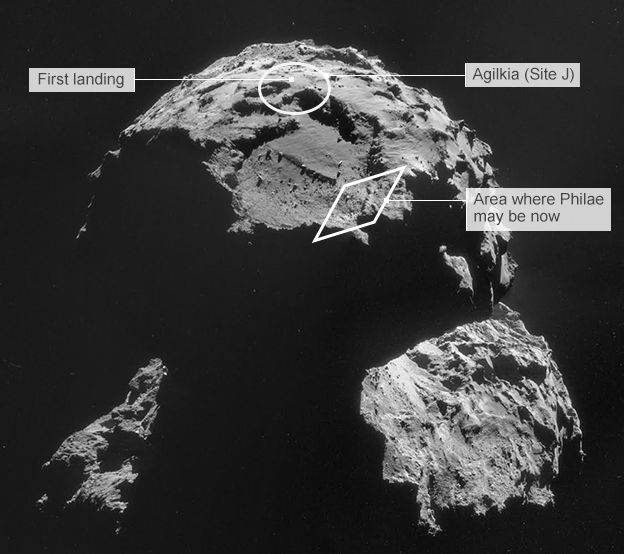
Some radio data suggests the probe may be about 1km from the intended landing site
After a historic but awkward comet landing, the robot probe Philae is now stable and sending pictures - but there are concerns about its battery life.

After two bounces, the first one about 1km back out into space, the lander settled in the shadow of a cliff, 1km from its intended target site.

It may now be problematic to get enough sunlight to charge its battery systems.

Launched in 2004, the European Space Agency (ESA) mission hopes to learn about the origins of our Solar System.

It has already sent back the first images ever taken from the crumbling, fractured terrain of a comet.

Philae got to the icy 67P/Churyumov-Gerasimenko on the back of Esa's Rosetta satellite after a 10-year, 6.4 billion-km (4bn-mile) journey, which reached its climax on Wednesday with a seven-hour drop to the surface.


Comment: Icy? All the pictures show a rocky surface devoid of any ice.


After showing an image that indicates Philae's presumed location - on the far side of a large crater that was earlier considered but then rejected as a landing site - the head of the lander team, Dr Stephan Ulamec, said: "We could be somewhere in the rim of this crater, which could explain this bizarre... orientation that you have seen."

Galaxy

Solar-system-wide climate change: Yet more extreme storms on Uranus

infrared images of Uranus
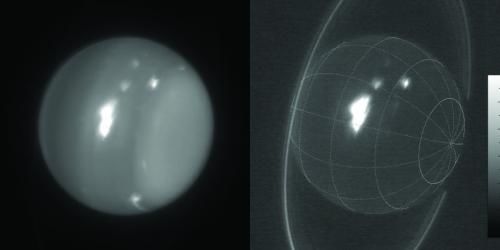
© Credit: Imke de Pater (UC Berkeley) & Keck Observatory images.These are infrared images of Uranus (1.6 and 2.2 microns) obtained on Aug. 6, 2014, with adaptive optics on the 10-meter Keck telescope. The white spot is an extremely large storm that was brighter than any feature ever recorded on the planet in the 2.2 micron band. The cloud rotating into view at the lower-right limb grew into the large storm that was seen by amateur astronomers at visible wavelengths.
The normally bland face of Uranus has become increasingly stormy, with enormous cloud systems so bright that for the first time ever, amateur astronomers are able to see details in the planet's hazy blue-green atmosphere.

"The weather on Uranus is incredibly active," said Imke de Pater, professor and chair of astronomy at the University of California, Berkeley, and leader of the team that first noticed the activity when observing the planet with adaptive optics on the W. M. Keck II Telescope in Hawaii.

"This type of activity would have been expected in 2007, when Uranus's once every 42-year equinox occurred and the sun shined directly on the equator," noted co-investigator Heidi Hammel of the Association of Universities for Research in Astronomy. "But we predicted that such activity would have died down by now. Why we see these incredible storms now is beyond anybody's guess."

In all, de Pater, Hammel and their team detected eight large storms on Uranus's northern hemisphere when observing the planet with the Keck Telescope on August 5 and 6. One was the brightest storm ever seen on Uranus at 2.2 microns, a wavelength that senses clouds just below the tropopause, where the pressure ranges from about 300 to 500 mbar, or half the pressure at Earth's surface. The storm accounted for 30 percent of all light reflected by the rest of the planet at this wavelength.

When amateur astronomers heard about the activity, they turned their telescopes on the planet and were amazed to see a bright blotch on the surface of a normally boring blue dot.

Comment: As well as these "increasingly stormy" conditions on Uranus, this year we have seen increased volcanic activity on Jupiters moon Io, scientists have been puzzled by the wobble of Saturn's moon Mimas and a major increase in asteroid activity has seen MIT astronomers upgrade the solar system from stable to dynamic

What is causing these recent Solar system wide climate changes?

We have also seen deluges, meteor fireballs, 'thunder-snow', unseasonal tornadoes, 'super-storms' here on the BBM this month.

Could it be part of an overall 'grounding' of our solar system, caused perhaps by the close approach of the system's Twin Sun?

Perhaps something wicked this way comes:


Comet 2

Eight billion asteroids in the Oort cloud?

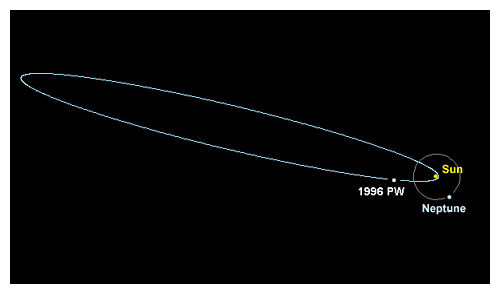
1996 PW
© JPL/HorizonsWhen discovered, the object 1996 PW looked like an asteroid but had the elongated, 5,900-year-long orbit of an Oort Cloud comet.
When a telescope atop Hawaii's Haleakala swept up a fast-moving object in August 1996, astronomers didn't know what to make of it. Designated 1996 PW, the little interloper had the highly elongated orbit of a comet that had ventured inward from the Oort Cloud, at the solar system's outermost fringe.

But it had no tail or coma - visually and spectroscopically, it looked like an asteroid.

At the time, dynamicists Paul Weissman (Jet Propulsion Laboratory) and Hal Levison (Southwest Research Institute) proposed that 1996 PW might actually be a rare hybrid: an asteroid from the Oort Cloud. Their suggestion ran completely counter to the consensus notion that only comets existed in that vast, distant reservoir. But Weissman and Levison had run the numbers: they calculated that, along with a trillion or so comets, roughly 8 billion asteroids could have been flung out into the Oort Cloud by close planetary encounters early in solar-system history.

When other researchers suggested that 1996 PW was probably just an "extinct" comet, having depleted the volatile ices that create a coma or tail, the notion of asteroids in the Oort Cloud got shelved - but not completely forgotten.

Comment:

Electric Universe: Tail discovered on long-known asteroid

Icy asteroids: Resident asteroids sprout comet-like dust tails


Beaker

Using human brainwaves to light up mouse gene expression

human brainwaves mouse genes
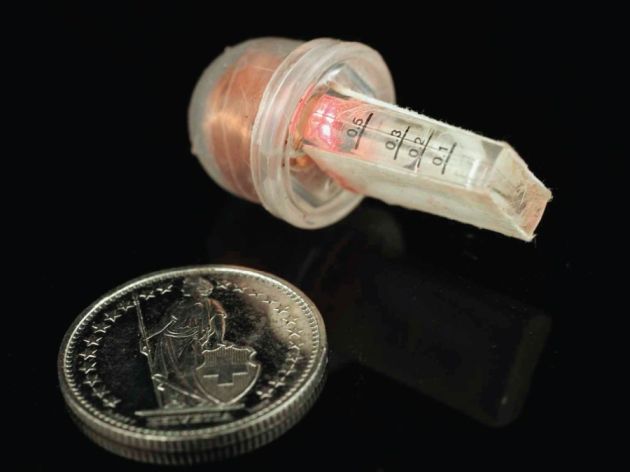
Researchers tested an implant containing human stem cells that had been engineered to produce a protein called secreted alkaline phosphatase.
A system that uses brain activity to switch on genes with light could give new meaning to the phrase 'mind over matter'. The set-up, which was tested in mice, might one day allow human patients to pre-empt pain or seizures by recognizing brain activity that signals the onset of these phenomena and intervening to stop them.

The findings, reported on 11 November in Nature Communications, are another advance in the burgeoning field of optogenetics, which uses light to control the activity of genes. But whereas many experimental systems still require an outside power source, the team led by Martin Fussenegger, a bioengineer at ETH Zurich in Switzerland, used the brain's own electricity - picked up by means of electroencephalography (EEG) - to provide power through a daisy-chain of signals.

Fireball 2

European spacecraft lands on comet

Image
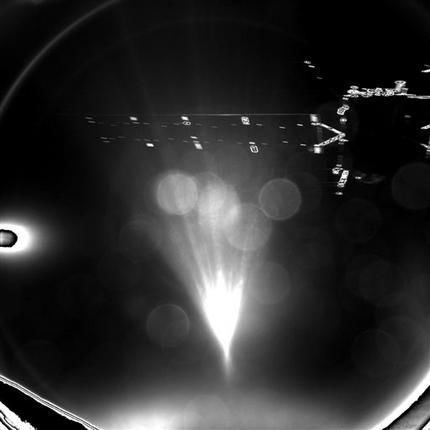
© AP Photo/ESAThe picture released by the European Space Agency ESA on Wednesday, Nov. 12, 2014 was taken by Rosetta's lander Philae shortly after its separation from the mother spaceship with the lander’s CIVA-P imaging system and captures one of Rosetta's 14 metre-long solar wings. On Wednesday, Nov. 12, 2014 the Philae lander detached from Rosetta and started it's descent to the 4-kilometer-wide (2.5-mile-wide) 67P/Churyumov-Gerasimenko comet.
The European Space Agency celebrated a cosmic touchdown Wednesday by successfully landing a spacecraft on a comet for the first time in history.

The agency said it has received a signal at 1603 GMT (11:03 a.m. EST) from the 100-kilogram (220-pound) Philae lander after it touched down on the icy surface of the comet named 67P/Churyumov-Gerasimenko.

"We definitely confirm that the lander is on the surface," said flight director Andrea Accomazzo.

While further checks are needed to ascertain the state of the lander, the fact that it is resting on the surface of the speeding comet is already a huge success. It marks the highlight of the decade-long Rosetta mission to study comets and learn more about the origins of these celestial bodies.

The head of the European Space Agency underlined Europe's pride in having achieved a unique first ahead of its U.S. counterpart NASA.

Beaker

Stem cells organize using geometry as a guide

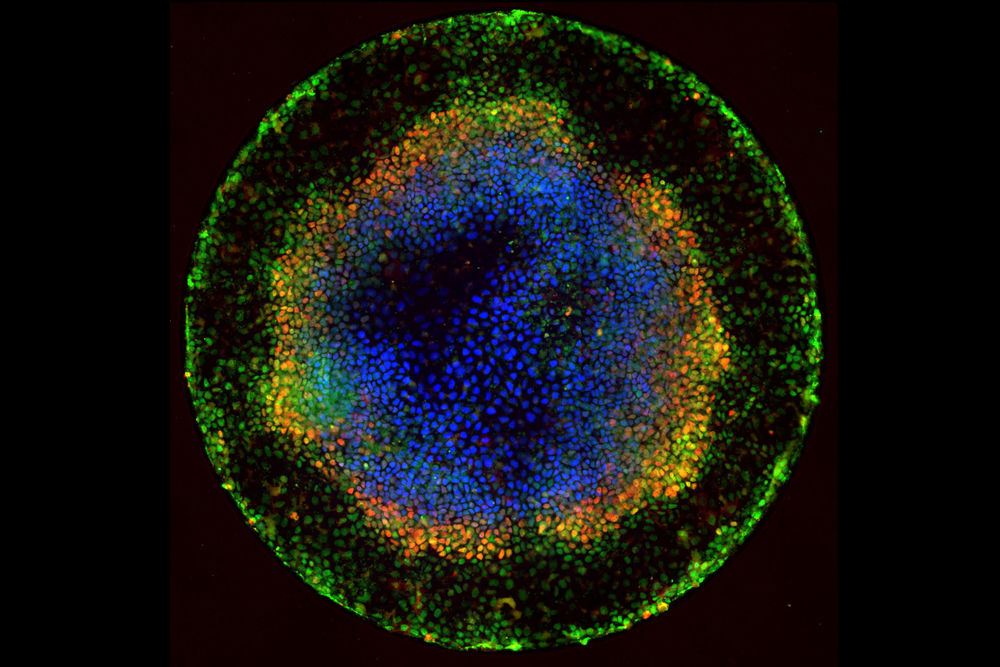
Each fluorescent point of light making up the multicolored rings in this image is an individual human embryonic cell in the early stages of development. These cells are the descendants of human embryonic stem (ES) cells, which have the potential to become any of roughly 200 cell types in the human body.
stem cell development
© Aryeh Warmflash, Rockefeller UniversityAs seen under a microscope, human embryonic cells (colored dots) confined to areas of precisely controlled size and shape start to specialize and form distinct layers similar to those seen in early development.

During normal embryonic development, ES cell descendants specialize, migrate and organize into distinct layers in a process called gastrulation. These layers then shape and fold into structures that give rise to different tissues, organs and limbs. Scientists seeking to understand the molecular cues responsible for early embryonic patterning have focused on finding the right mix of chemical signals, called growth factors, that would allow them to replicate the process in the lab. But a very different approach by a team of National Institutes of Health-funded developmental biologists and physicists at Rockefeller University indicates that a critical element is geometrical.

"Thanks to our diverse scientific perspectives, we were in a good position to realize that geometry could be an important factor," says developmental biologist Ali Brivanlou, who led the team with physicist Eric Siggia. A former postdoctoral researcher trained in theoretical physics, Aryeh Warmflash, also played a big role.

Comment: It appears the cells are directing their development according to the information they receive from their environment. As above, so below. For more on information theory and how it may apply to everyday life, see Pierre Lescaudron and Laura Knight-Jadczyk's new book, Earth Changes and the Human-Cosmic Connection.


Binoculars

Experts exploring depths of frozen Siberian mystery crater to understand its origins

Image
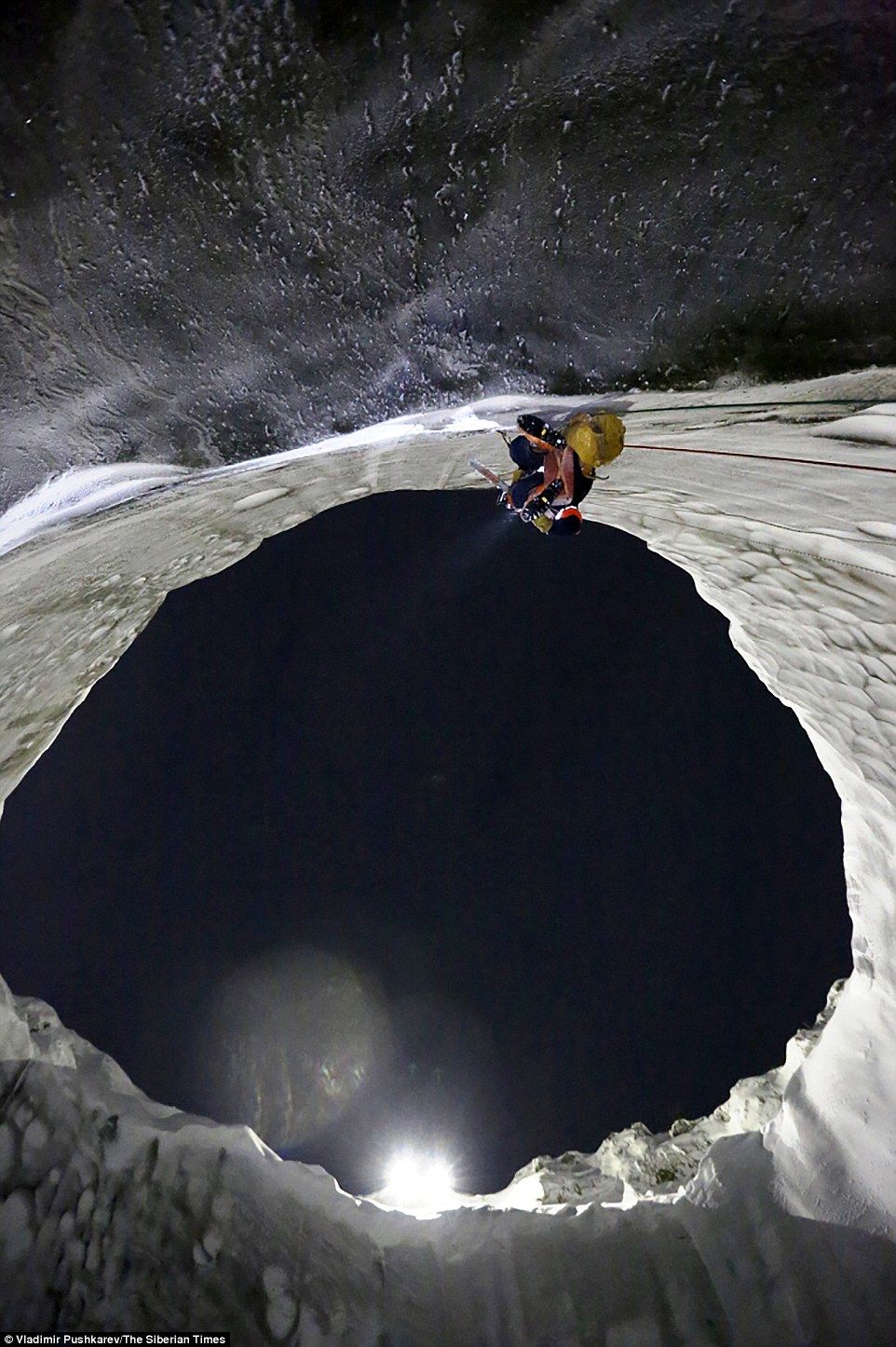
When frozen, the accessible parts of crater (pictured from below) are around 54ft (16.5 metres) deep, and scientists captured these latest remarkable images by using climbing gear to reach a frozen lake 34ft (10.5 metres) at the bottom. It is thought the crater was formed when heating from underground fissures released gas hydrates causing the dramatic blowout
Remarkable new images have emerged showing the haunting beauty of a mysterious Siberian crater.

The photographs were released as it was revealed scientists are monitoring satellite images to check for other similar holes in northern Russia in a desperate attempt to understand their origin.

And, for the first time, Siberian scientists have used climbing gear to reach a frozen lake 34ft (10.5 metres) deep in the hole to carry out tests.

Comment: See also: Russian scientists suggest Siberian exploding holes 'are the key to Bermuda Triangle'