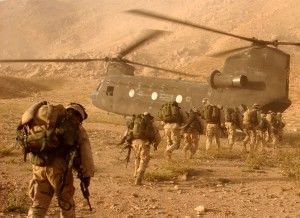
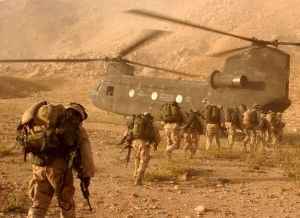
© news.agu.orgSoldiers walk to the ramp of the CH-47 Chinook helicopter that will return them to Kandahar Army Air Field. New models will help predict the impact of plasma bubbles on future missions.
Twelve years ago, a U.S. military rescue mission in Afghanistan went horribly wrong. A Chinook helicopter carrying U.S. troops failed to receive a crucial radio message and was shot down over the snow-covered peak of Takur Ghar.
But the radio failure was not caused by malfunctioning equipment. Instead,
a giant, 62-mile-long (100 kilometers) "plasma bubble" made up of clouds of electrically charged particles was responsible for the communication blackout, new research suggests.
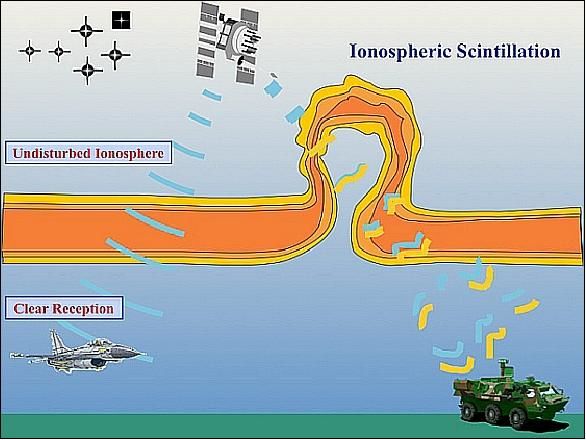
Michael Kelly, a researcher at the Johns Hopkins University Applied Physics Lab (APL), in Laurel, Maryland, started to put the pieces together after reading a journalist's account of the Battle of Takur Ghar. He suspected the radio failure was caused by a little-known space weather effect caused by these mysterious plasma bubbles.
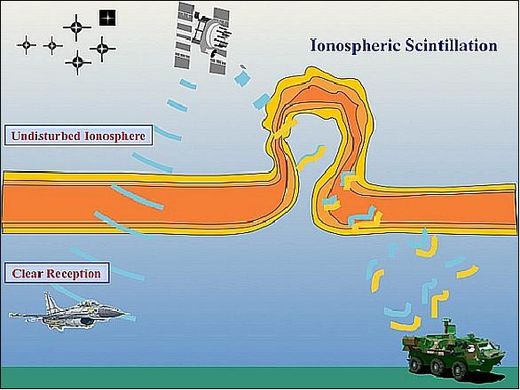
© www.jhuapl.eduPlasma Bubbles: Tendrils of low-density charged particles with turbulence at their edges can skew radio frequency waves passing through them.
During daylight hours in the upper atmosphere,
radiation beaming down from the sun rips electrons from their atoms. But once the sun sets, the electrons start recombining with their atoms. This recombination process happens faster in the lower atmosphere because there are heavier particles there, and electrons recombine faster with molecules than they do with single atoms.
Since the plasma in this part of the atmosphere is less dense, it rises and burrows into the denser plasma above. This causes giant bubbles of charged particles to form, similar to the way air bubbles rise from a submerged diver.















Comment: Why such levity from Mr. Edelhart when writing about totalitarianism? Stevie Wonder could see that this is nothing to be lighthearted about.
See:
Beyond Orwell's worst nightmare
2011: A Brave New Dystopia