Science & Technology
Charles Q. Choi
msnbc LiveScience
Tue, 16 Oct 2007 16:24 CDT
A three-way sex struggle resembling the game rock-paper-scissors may have existed for 175 million years or more in lizards, research now suggests.
Comment: As above - so below. It is fascinating to observe how certain types of behaviour in the animal or plant kingdoms closely parallel those found in humans.
One has to wonder, too - would these imprinted patterns extend to beings of a higher-dimensional nature...?
Space War
Tue, 16 Oct 2007 14:59 CDT
Boeing has successfully demonstrated that its Avenger-mounted laser system can neutralize the kinds of improvised explosive devices (IEDs) and unexploded ordnance (UXO) that threaten U.S. troops deployed in war zones. During laser firings Sept. 26-27 at Redstone Arsenal in Huntsville, Ala., the Laser Avenger engaged and destroyed five targets representing IED and UXO threats.
|
| ©Unknown
|
| The laser segment of Laser Avenger will have uses beyond the counter-IED, counter-UXO mission. For instance, it could be upgraded to have a shoot-on-the-move capability and to destroy other kinds of targets, including low-flying unmanned aerial vehicles.
|
Comment: Yes, it most certainly could. Afraid yet?
Linda Rosencrance
Computerworld
Tue, 16 Oct 2007 14:51 CDT
Google Inc. has launched a video-blocking tool that will allow content owners to intercept copyrighted clips as they're uploaded to YouTube, its video-sharing site.
The tool, called YouTube Video Identification, is in beta testing.
"Video Identification is the next step in a long list of content policies and tools that we have provided copyright owners so that they can more easily identify their content and manage how it is made available on YouTube," said David King, YouTube product manager, in the blog post.
Kristina Peterson
Inside Bay Area
Tue, 16 Oct 2007 14:34 CDT
Scientists at the Stanford University School of Medicine studying the mysteries of sleep have discovered a new model for their research - and it's swimming around their laboratory.
Emmanuel Mignot, the Stanford scientist who discovered the cause of narcolepsy first in dogs and later in humans, has successfully shown that common zebrafish can develop insomnia.
The finding paves the way for future study of humans, who have many of the same sleep-producing chemicals, he said Monday.
Physorg
Tue, 16 Oct 2007 11:41 CDT
Gossip may do more to shape a person's opinion than facts they know to be true, even when the chit-chat contradicts the evidence, a study released Monday said.
Stephen Shankland
CNet News.com
Tue, 16 Oct 2007 02:47 CDT
SLR leader Canon announced Monday it's developing two high-end image-stabilized telephoto lenses, the EF 200mm f/2L IS USM and the EF 800mm f/5.6L IS USM.
Robin McKie
The Observer
Tue, 16 Oct 2007 02:08 CDT
New images of a giant planet's satellites taken by the 10-year Cassini probe have excited scientists.
Associated Press
Mon, 15 Oct 2007 22:24 CDT
POCATELLO, Idaho - Idaho State University anthropologists are retracing American Indian trade routes by bombarding arrowheads and other stone tools with radiation that helps locate their origins.
Michael Astor
Associated Press
Mon, 15 Oct 2007 21:45 CDT
The skeleton of what could be a new dinosaur species - a giant, Patagonian plant-eater - has been uncovered in Argentina. At more than 105 feet, it is among the largest ever found, scientists said Monday.
|
| ©AFP
|
Scientists from Argentina and Brazil said the Patagonian dinosaur appears to represent a previously unknown species because of the unique structure of its neck. They named it
Futalognkosaurus dukei after the Mapuche Indian words for "giant" and "chief," and for Duke Energy Argentina, which helped fund the skeleton's excavation.
Amber Haq
Business Week
Mon, 15 Oct 2007 16:12 CDT
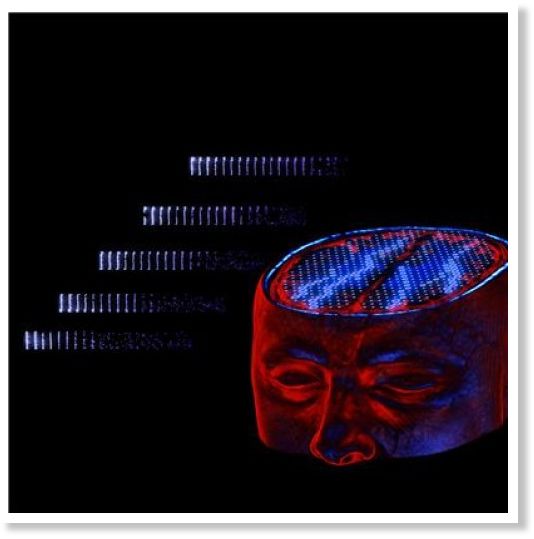
Neuromarketers use sophisticated brain-imaging technology to test consumer response and help clients fine-tune their strategies
Do you ever get the creepy feeling that advertisers know how to put a lump in your throat, inspire subconscious brand loyalty, or make your mouth water? Just wait: It could get worse. An emerging technique called neuromarketing that uses brain scans to measure human response to promotional messages is starting to catch on in Europe - and soon ads may become even more effective at prompting you to pull out your wallet.
Comment: Given that the military and CIA are some 30 years ahead of public research into such areas as this - thanks to Project Paperclip which brought over the Nazi scientists to the US, Project Bluebird, MK-ULTRA, Monarch and the like - one wonders how easily they are able to manipulate the public to "buy" their nefarious policies or to predict reactions from "terrorist" events. Yet another reason to believe 9/11 was just such a neuromarketing tool.
Comment: As above - so below. It is fascinating to observe how certain types of behaviour in the animal or plant kingdoms closely parallel those found in humans.
One has to wonder, too - would these imprinted patterns extend to beings of a higher-dimensional nature...?