
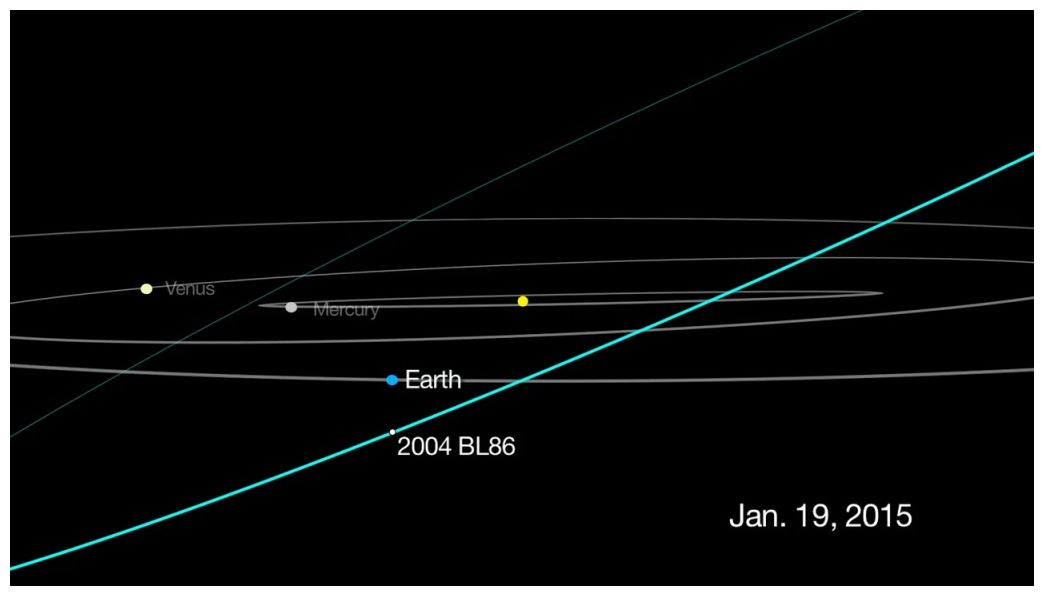
© NASA/JPL-CaltechNASA caption: This graphic depicts the passage of asteroid 2004 BL86, which will come no closer than about three times the distance from Earth to the moon on Jan. 26, 2015. Due to its orbit around the sun, the asteroid is currently only visible by astronomers with large telescopes who are located in the southern hemisphere. But by Jan. 26, the space rock’s changing position will make it visible to those in the northern hemisphere.
Don Yeomans, who on January 9 retired as manager of NASA's Near Earth Object Program Office after 16 years in the position, said:
The asteroid is expected to be observable to amateur astronomers with small telescopes and strong binoculars beginning in the evening of January 26 and into the morning of January 27. Its peak brightness will be about magnitude 8.8, meaning it will not be bright enough to view with the unaided eye. The asteroid will be at its most visible over Europe, Africa, and North and South America. Australians and east Asians will have to look a few hours earlier, when the asteroid isn't as bright. The asteroid will be moving about four degrees every hour through the course of the night. That's fast, faster than the moon moves (about half a degree per hour). The asteroid will be whizzing past in front of the constellations Hydra, Cancer, and Leo.Monday, January 26 will be the closest asteroid 2004 BL86 will get to Earth for at least the next 200 years. And while it poses no threat to Earth for the foreseeable future, it's a relatively close approach by a relatively large asteroid, so it provides us a unique opportunity to observe and learn more.















Comment:
Potentially dangerous asteroid to fly by Earth on January 26