
© Sarah Lazarovic for The National
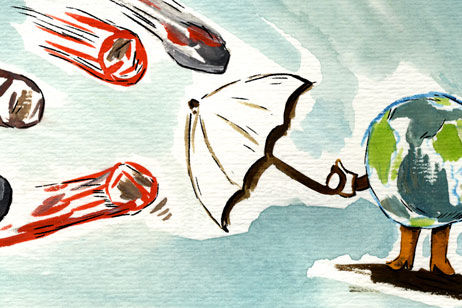
Four months later and we are ducking again, but this time the author of our fear is not some rocket scientist who forgot that what goes up must come down, but the universe itself.
It isn't, it turns out, the old tin cans we should be concerned about so much as the thousands of Near-Earth Objects (NEO) - asteroids large and small - heading our way, some with the potential to explode in our atmosphere with the force of a nuclear arsenal and cause an Extinction Level Event.
Remember the dinosaurs? Well exactly.
The good news is that we are getting quite good at spotting these things. So far Nasa, which began looking in earnest in 2005, has discovered 8,000, with another 70 popping up every month.
The bad news is that we aren't yet good enough at spotting them and, even if we did spot one about to bash into is, there isn't much we could do about it.
Take the asteroid 2012 BX34, an 11-metre rock that whipped past the planet at about 8pm UAE time last Friday: 60,000 kilometres might not sound like a near-miss, but that's just one sixth of the distance to the Moon and, travelling at close to 50,000kph, BX34 was just a little over an hour away from dropping in.
And, in a nutshell, we didn't see it coming - the first anyone knew about it was the previous Wednesday. And BX34's near-miss barely made it into the top-20 of such near misses.
"There is," Gareth Williams of the Minor Planet Centre told the BBC, after some no-doubt fevered calculations, "absolutely no chance of it hitting us" - which was just as well, as a paper published last week, with impeccable timing, made clear.
"There is currently no concerted international plan addressing the impact threat and how to organise, prepare and implement mitigation measures," was the headline point from the paper, 'A Global Approach to Near-Earth Object Impact Threat Mitigation', written by a collaborating group of scientists from the US, UK, Russia, Germany, France and Spain.
There is no shortage of ideas, say the scientists - just a shortage of political will and cash to get them off the drawing board: in theory, "kinetic impactor" spacecraft could be launched, a so-far entirely imaginary "Gravity tractor" could be deployed on sentry duty or (and this, you will remember, was Bruce Willis's favourite option, as modelled in the 1998 film Armageddon), we could nuke 'em.
But whatever solution we choose, we should choose it soon. Looming just over the horizon is the potentially apocalyptic asteroid Apophis - and the clue is in the name. Apophis was an ancient Egyptian demon, aka The Uncreator.
This 330m-wide rock is due to come awfully close in 2029 - just 29,470 km close, says Nasa - but it will miss us. Phew.
When it returns in 2036, however, there could be "a small estimated chance of impact" (though "less than 1 in 45,000" doesn't sound that small) while new measurements possible in 2013 would "likely confirm" that Apophis will miss us by millions of kilometres.
Likely? Sort of reassuring. Except Russian scientists don't agree.
What's "likely" for them, said Professor Leonid Sokolov of the St Petersburg State University, is that a "collision with Earth may occur on April 13, 2036".
Nasa remains sanguine. "The threat to any one person from auto accidents, disease, other natural disasters and a variety of other problems is much higher than the threat from NEOs," it says.
"Our best insurance rests with the NEO scientists and their efforts to first find these objects and then track their motions into the future."
Fine. But then what? Send for Bruce?









The fantasy is that there is anything beyond civil defense that can be done in case of a major impact event. Given enough warning it might be possible to get a few folks out of the way, or in bunkers. But I wouldn't bet my life on anyones ability to turn a major impactor aside.
Take a look at images of comets SW3 or Linear. Both are common, heavily fragmented comets in short period, Earth-crossing orbits. Yet all of our impact research on mitigation strategies is based on the naive assumption that any major impact event we have to face will be the result of a single, solid, body.
If a cloud of debris, or a cluster of comet fragments, such as that were to hit soon after the kind of total breakup both of those objects underwent (And it’s only a matter of time before one does) the consequences will bare no resemblance whatsoever to anything anyone has imagined.
The reason that Craters are so rare on Earth is not because extinction level impact events are rare. It is because most extinction level events consist of clouds of cometary debris; not lone solid objects. So you get something like ten thousand Tunguska class airbursts in just a few seconds. These events don’t make craters. That’s not to say that there is no planetary scarring involved. It’s just that instead of getting smashed into a nice round crater, the ground gets flash melted, ablated, and blown away like butter under a blowtorch.
Expect it to come in at about 30 kilometers per second. Only the first fragments on the leading edged of the cluster will fall into cold atmosphere. The rest will be falling into the already superheated impact plumes of those that went before. And they’ll just crank up the heat, and pressure.
You’ve read that “The meek shall inherit the Earth”, right? Well the only ones in the impact zones who will survive a multiple fragment airburst event like that will be the folks hiding deep underground in caves, or bunkers. If you are on the surface, and close enough to see it, the radiant energy of a multiple airburst event will be so intense that you will probably be vaporized before the image registers in your consciousness.
The only thing unusual about the Tunguska event of 1908 was that it was a lone fragment. And at only 50 megatons of destructive force, it was such a puny little thing.