
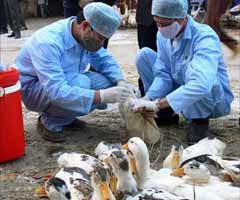
© AFP/deHK officials check ducks for avian bird flu.
The birds were found on January 29 and 31 on a beach on Lantau island and preliminary tests showed they had tested positive for H5 avian influenza.
Further tests confirmed it was the H5N1 strain of the virus, a spokesman for the Agriculture, Fisheries and Conservation Department said in a statement.
Two more dead chickens were collected on the island on Wednesday, the spokesman said, adding that preliminary tests for the H5 virus were being arranged.
Earlier, officials said a total of 17 dead birds had washed up on beaches on the mostly rural island in recent days.
H5N1 was found in a chicken at a Hong Kong poultry farm in December, prompting the slaughter of more than 90,000 chickens.
Hong Kong was the scene of the world's first reported major H5N1 bird flu outbreak among humans in 1997, when six people died. The deadly virus has killed about 250 people worldwide since late 2003.



One must wonder if these reinfection efforts are going to be more successful than in the past. Irrespective of how H5N1 came into being, something is holding it back from decimating the population of Earth.
Some interesting facts about the gorgeous and all-inspiring Lantau Island:
- the largest island in Hong Kong
- Originally the site of sleepy fishing villages, the island has in recent years been transformed with the development of several major infrastructure projects, including Hong Kong's new international airport, Ngong Ping 360 and Hong Kong Disneyland
- Artifacts unearthed on the island show human activities dated back to the Neolithic Age and the Bronze Age
- Lantau Island is often referred to as "the lungs of Hong Kong", because of its abundance of indigenous forest and relative scarcity of high-rise residential developments
- Discovery Bay is a privately owned residential development located on the north-eastern coast of Lantau. It has a current population of around 14,300 residents from over 30 different countries - gaining it a reputation as an expatriate enclave
- Tian Tan Buddha is a large bronze statue of the Buddha and located at Ngong Ping, Lantau Island. The statue is located near Po Lin Monastery and symbolizes the harmonious relationship between man and nature, people and religion. It is a major center of Buddhism in Hong Kong, and is also a popular tourist attraction