
|
| ©Unknown |
| Missing Magnetic Field |
But that may just be part of the story.
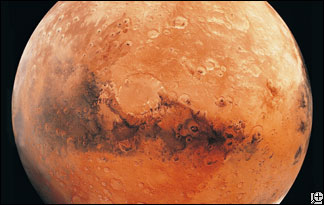
A team of researchers led by Jafar Arkani-Hamed of the University of Toronto in Canada believe a large asteroid circling the planet set up a gravitational tug-of-war that got Mars' core churning. Eventually, the asteroid lost its grip and crashed into its parent planet. Mars paid a dear price as well. Without the tidal forces, the planet's core lost its momentum, killing off the magnetic field.
What remain are patches of strong magnetic imprints in the oldest parts of Mars' crust. Because the fresher surface features are magnetic-free, scientists believe Mars lost its shield about four billion years ago.
What remain are patches of strong magnetic imprints in the oldest parts of Mars' crust. Because the fresher surface features are magnetic-free, scientists believe Mars lost its shield about four billion years ago.
Laboratory tests and computer simulations by Arkani-Hamed and colleagues and published in the Journal of Geophysical Research last month show a large asteroid circling about 46,000 miles above Mars could have had a strong enough pull on Mars to coax its liquid core into moving. The dynamic would have lasted about 400 million years before the asteroid crashed, demagnetizing Mars.
"Once it impacted, there were no tidal forces anymore so it couldn't power the dynamo," Arkani-Hamed told Discovery News.
The theory could explain why Mars' vigorous core suddenly grew still.
"Maybe a core dynamo wasn't powered by convection, but by asteroid tidal forces," he said.
Walter Kiefer with the Lunar & Planetary Institute in Houston follows the logic, but doesn't see how an asteroid as large as the one needed to tug Mars' core would have been captured by the planet's gravity in the first place.
"I just don't know how to dissipate the energy to get it into orbit around Mars, " he said. "Until that step is made, it's hard for me to regard this as the right model."
The loss of Mars' magnetic field may have played a critical role in the planet's evolution from the warm and wet world scientists suspect it was into the cold, dry desert that exists today.
Magnetic fields, similar to Earth's, protect planets from cosmic rays. They also help maintain the atmosphere by shielding molecules from solar radiation.



Reader Comments
to our Newsletter