
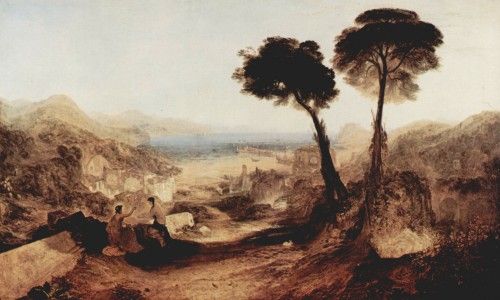
© WikicommonsBaiae and the Bay of Naples, painted by J.M.W. Turner in 1823, well before modernization of the area obliterated most traces of its Roman past.
The Fields, in short, are hellish, and it is no surprise that in Greek and Roman myth they were associated with all manner of strange tales. Most interesting, perhaps, is the legend of the Cumæan sibyl, who took her name from the nearby town of Cumæ, a Greek colony dating to about 500 B.C. - a time when the Etruscans still held sway much of central Italy and Rome was nothing but a city-state ruled over by a line of tyrannical kings.
The sibyl, so the story goes, was a woman named Amalthaea who lurked in a cave on the Phlegræan Fields. She had once been young and beautiful - beautiful enough to attract the attentions of the sun god, Apollo, who offered her one wish in exchange for her virginity. Pointing to a heap of dust, Amalthaea asked for a year of life for each particle in the pile, but (as is usually the way in such old tales) failed to allow for the vindictiveness of the gods. Ovid, in Metamorphoses, has her lament that "like a fool, I did not ask that all those years should come with ageless youth, as well." Instead, she aged but could not die. Virgil depicts her scribbling the future on oak leaves that lay scattered about the entrance to her cave, and states that the cave itself concealed an entrance to the underworld.
The best-known - and from our perspective the most interesting - of all the tales associated with the sibyl is supposed to date to the reign of Tarquinius Superbus - Tarquin the Proud. He was the last of the mythic kings of Rome, and some historians, at least, concede that he really did live and rule in the sixth century B.C. According to legend, the sibyl traveled to Tarquin's palace bearing nine books of prophecy that set out the whole of the future of Rome. She offered the set to the king for a price so enormous that he summarily declined - at which the prophetess went away, burned the first three of the books, and returned, offering the remaining six to Tarquin at the same price. Once again, the king refused, though less arrogantly this time, and the sibyl burned three more of the precious volumes. The third time she approached the king, he thought it wise to accede to her demands. Rome purchased the three remaining books of prophecy at the original steep price.
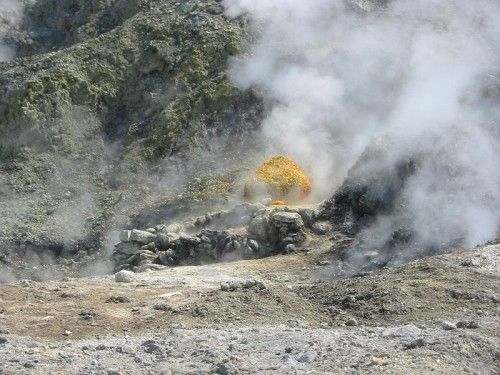
© WikicommonsSulfur drifts from a vent on the barren volcanic plateau known as the Phlegraean Fields, a harsh moonscape associated with legends of prophecy.
The existence of the Sibylline Books certainly suggests that Rome took the legend of the Cumæan sibyl seriously, and indeed the geographer Strabo, writing at about the time of Christ, clearly states that there actually was "an Oracle of the Dead" somewhere in the Phlegræan Fields. So it is scarcely surprising that archaeologists and scholars of romantic bent have from time to time gone in search of a cave or tunnel that might be identified as the real home of a real sibyl - nor that some have hoped that they would discover an entrance, if not to Hades, then at least to some spectacular subterranean caverns.
Over the years several spots, the best known of which lies close to Lake Avernus, have been identified as the antro della sibilla - the cave of the sibyl. None, though, leads to anywhere that might reasonably be confused with an entrance to the underworld. Because of this, the quest continued, and gradually the remaining searchers focused their attentions on the old Roman resort of Baiæ (Baia), which lies on Bay of Naples at a spot where the Phlegræan Fields vanish beneath the Tyrrhenian Sea. Two thousand years ago, Baiæ was a flourishing spa, noted both for its mineral cures and for the scandalous immorality that flourished there. Today, it is little more than a collection of picturesque ruins - but it was there, in the 1950s, that the entrance to a hitherto unknown antrum was discovered by the Italian archaeologist Amedeo Maiuri. It had been concealed for years beneath a vineyard; Maiuri's workers had to clear a 15-foot-thick accumulation of earth and vines.
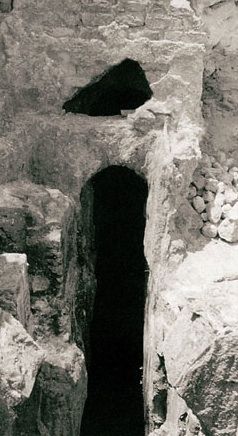
The narrow entrance to the tunnel complex at Baiae is easy to miss amid the ruins of a Greek temple and a large Roman bath complex.
Paget was not a professional archaeologist. He was a Briton who worked at a nearby NATO airbase, lived in Baiæ, and excavated mostly as a hobby. As such, his theories need to be viewed with caution, and it is worth noting that when the academic Papers of the British School at Rome agreed to publish the results of the decade or more that he and an American colleague named Keith Jones spent digging in the tunnel, a firm distinction was drawn between the School's endorsement of a straightforward description of the findings and its refusal to pass comment on the theories Paget had come up with to explain his perplexing discoveries. These theories eventually made their appearance in book form but attracted little attention - surprisingly, because the pair claimed to have stumbled across nothing less than a real-life "entrance to the underworld."
Paget was one of the handful of men who still hoped to locate the "cave of the sibyl" described by Virgil, and it was this obsession that made him willing to risk the inhospitable interior. He and Jones pressed their way though the narrow opening and found themselves inside a high but narrow tunnel, eight feet tall but just 21 inches wide. The temperature inside was uncomfortable but bearable, and although the airless interior was still tinged with volcanic fumes, the two men pressed on into a passage that, they claimed, had probably not been entered for 2,000 years.
Following the tunnel downward, Paget and Jones calculated that it fell only around 10 feet in the first 400 feet of its length before terminating in a solid wall of rubble that blocked the way. But even the scanty evidence the two men had managed to gather during this early phase of their investigation persuaded them that it was worth pressing on. For one thing, the sheer amount of spoil that had been hauled into the depths suggested a considerable degree of organization - years later, when the excavation of the tunnel was complete, it would be estimated that 700 cubic yards of rubble, and 30,000 man-journeys, had been required to fill it. For another, using a compass, Paget determined that the terrace where the tunnel system began was oriented towards the midsummer sunrise, and hence the solstice, while the mysterious passage itself ran exactly east-west and was, thus, on the equinoctial sunrise line. This suggested that it served some ritual purpose.
It took Paget and Jones, working in difficult conditions with a small group of volunteers, the beter part of a decade to clear and explore what turned out to be a highly ambitious tunnel system. Its ceremonial function seemed to be confirmed by the existence of huge numbers of niches for oil lamps - they occurred every yard in the tunnels' lower levels, far more frequently than would have been required merely to provide illumination. The builders had also given great thought to the layout of the complex, which seemed to have been designed to conceal its mysteries.
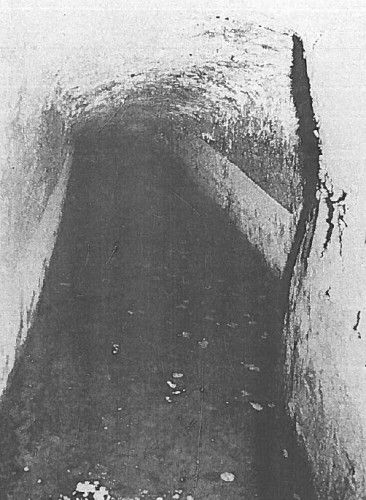
The "River Styx" - an underground stream, heated almost to boiling point in places, which runs through at the deepest portions of the tunnel complex. It was the discovery of this stream that led Paget to formulate his daring hypothesis that the Great Antrum was intended as a representation of the mythic underground passageways to Hades.
But only when the men went deeper into the hillside did the greatest mystery of the tunnels revealed itself. There, hidden at the bottom of a much steeper passage, and behind a second S-bend that prevented anyone approaching from seeing it until the final moment, ran an underground stream. A small "landing stage" projected out into the sulfurous waters, which ran from left to right across the tunnel and disappeared into the darkness. And the river itself was hot to the touch - in places it approached boiling point.
Conditions at this low point in the tunnel complex certainly were stygian. The temperature had risen to 120 degrees Fahrenheit; the air stank of sulfur. It was a relief to force a way across the stream and up a steep ascending passage on the other side, which eventually opened into an antechamber, oriented this time to the helical sunset, that Paget dubbed the "hidden sanctuary." From there, more hidden staircases ascended to the surface to emerge behind the ruins of water tanks that had fed the spas at the ancient temple complex.
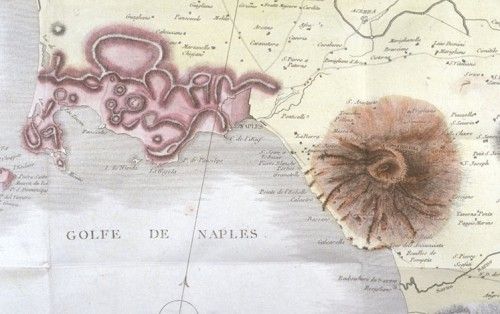
The Phlegræan Fields (left) and Mount Vesuvius, after Scipione Breislak's map of 1801. Baiae lies at the northeastern tip of the peninsula of Bacoli, at the extreme westerly end of the Fields.
The tunnel system, the two men proposed, had been constructed by priests to mimic a visit to the Greeks' mythical underworld. In this interpretation, the stream represented the fabled River Styx, which the dead had to cross to enter Hades; a small boat, the explorers speculated, would have been waiting at the landing stage to ferry visitors across. On the far side these initiates would have climbed the stairs to the hidden sanctuary, and it was there they would have met... who? One possibility, Paget thought, was a priestess posing as the Cumæan sibyl, and for this reason he took to calling the complex the "Antrum of Initiation."
The tunnels, then, in Paget's view, might have been constructed to allow priests to persuade their patrons - or perhaps simply wealthy travelers - that they had traveled through the underworld. The scorching temperatures below ground and the thick drifts of volcanic vapor would certainly have given that impression. And if visitors were tired, befuddled or perhaps simply drugged, it would have been possible to create a powerfully otherworldly experience capable of persuading even the skeptical.
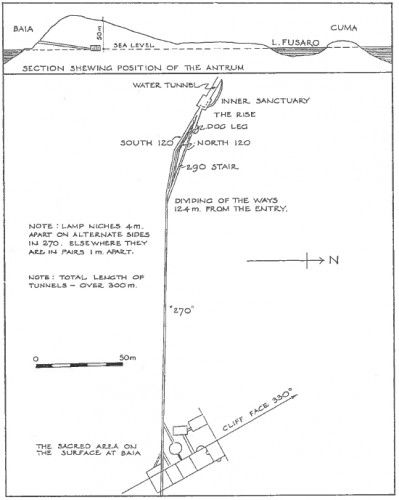
A general plan of the tunnel complex, drawn by Robert Paget.
Dating the construction of the complex was a greater challenge. The explorers found little evidence inside the tunnels that might point to the identity of the builders - just a mason's plumb bob in one of the niches and some ancient graffiti. But, working on the assumption that the passages had formed part of the surrounding temple complex, they concluded that they could best be dated to the late archaic period around 550 B.C. - at pretty much the time, that is, that the Cumæan sibyl was said to have lived. If so, the complex was was almost certainly the work of the Greek colonists of Cumæ itself. As for when the tunnels had been blocked up, that - Paget thought - must have taken place after Virgil's time, during the early Imperial period of Roman history. But who exactly ordered the work, or why, he could not say.
In time, Paget and Jones solved at least some of the Great Antrum's mysteries. In 1965 they persuaded a friend, Colonel David Lewis of the U.S. Army, and his son to investigate the Styx for them using scuba apparatus. The two divers followed the stream into a tunnel that dramatically deepened and discovered the source of its mysterious heat: two springs of boiling water, superheated by the volcanic chambers of the Phlegræan Fields.
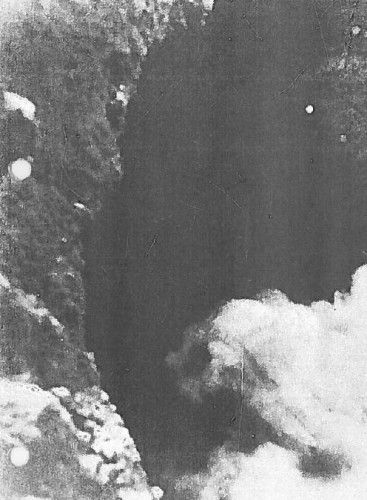
© Colonel David Lewis, U.S. ArmyOne of the two boiling springs that feed the "Styx," photographed in 1965, 250 feet beneath the surface .
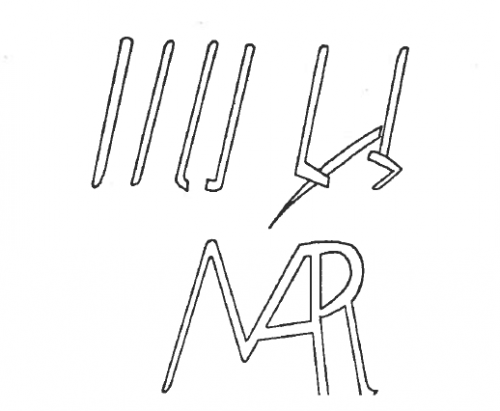
Paget found one foot-high fragment of roughly painted graffiti close to the entrance of the tunnels. He interpreted the first line to read "Illius" ("of that"), and the second as a shorthand symbol representing a prayer to the Greek goddess Hera.
Little seems to have changed at Baiæ since Paget's day. His discoveries have made remarkably little impact on tourism at the ancient resort, and even today the network of passages he worked so long to clear remain locked and barely visited. A local guide can be hired, but the complex remains difficult, hot and uncomfortable to visit. Little attempt is made to exploit the idea that it was once thought to be an entrance to the underworld, and, pending reinvestigation by trained archaeologists, not much more can be said about the tunnels' origin and purpose. But even among the many mysteries of the ancient world, the Great Antrum on the Bay of Naples surely remains among the most intriguing.
Sources
C.F. Hardie. "The Great Antrum at Baiae." Papers of the British School at Rome 37 (1969); Peter James and Nick Thorpe. Ancient Inventions. London: Michael O'Mara, 1995; A.G. McKay.
Cumae and the Phlegraean Fields. Hamilton, Ont: Cromlech Press, 1972; Daniel Ogden. Magic, Witchcraft and Ghosts in the Greek and Roman Worlds: A Sourcebook. Oxford: Oxford University Press, 2002; R.F. Paget.
"The 'Great Antrum' at Baiae: a Preliminary Report. Papers of the British School at Rome 35 (1967); R.F. Paget.
In the Footsteps of Orpheus: The Story of the Finding and Identifications of the Lost Entrance to Hades, the Oracle of the Dead, the River Styx and the Infernal Regions of the Greeks. London: Robert Hale, 1967; H.W. Parke.
Sibyls and Sibylline Prophecy in Classical Antiquity. London: Routledge, 1988; P.B. Wale.
"A conversation for 'The Antrum of Initiation, Baia. Italy'." BBC h2g2, accessed 12 August 2012; Fikrut Yegul.
"The Thermo-Mineral Complex at Baiae and De Balneis Puteolanis." The Art Bulletin 78:1, March 1996



Reader Comments
to our Newsletter