
© Shutter/VLADGRIN
Researchers say the data could help doctors determine what specific cognitive obstacles their patients might face after a brain injury.
For the study, neuroscientists at the California Institute of Technology (Caltech) examined 30 years worth of data from the University of Iowa's brain lesion patient registry and mapped brain activity in almost 350 people with lesions in their frontal lobes.
They linked these maps with data on how each patient performed in certain cognitive tasks.
With this information, the researchers could see exactly which parts of the frontal lobe were critical for different tasks like behavioral control (refraining from ordering a chocolate sundae) and reward-based decision making (trying to win money at a casino), a statement from Caltech explained.
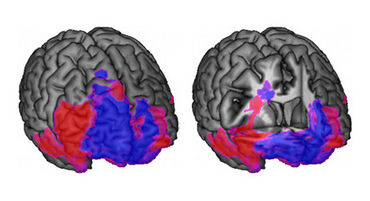
© California Institute of TechnologyMRI scans of a human brain show the regions significantly associated with decision-making in blue, and the regions significantly associated with behavioral control in red. On the left is an intact brain seen from the front — the colored regions are both in the frontal lobes. The image on the right is that same brain with a portion of the frontal lobes cut away to show how the lesion map looks in the interior.
Caltech researcher Ralph Adolphs explained that several different parts of the brain might be activated during a particular type of decision-making. And the maps show which parts of the frontal lobe are the most critical areas that, if damaged, could result in lifelong impairment.
"That knowledge will be tremendously useful for prognosis after brain injury," Adolphs said in the Caltech statement. "Many people suffer injury to their frontal lobes - for instance, after a head injury during an automobile accident - but the precise pattern of the damage will determine their eventual impairment."
The research was published in the Proceedings of the National Academy of Sciences.



Reader Comments
to our Newsletter